News|Articles|May 15, 2017
- Pharmaceutical Technology-05-15-2017
- Volume 2017 eBook
- Issue 1
Developing an Injectable Compound for a Dual- Chamber Delivery System
Author(s)Joerg Zimmermann
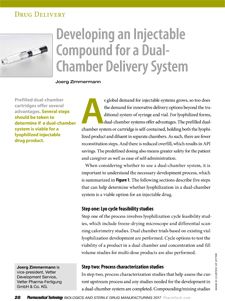
Prefilled dual-chamber cartridges offer several advantages. Several steps should be taken to determine if a dual-chamber system is viable for a lyophilized injectable drug product.
Advertisement
As global demand for injectable systems grows, so too does the demand for innovative delivery options beyond the traditional system of syringe and vial. For lyophilized forms, dual-chamber systems offer advantages.
When considering whether to use a dual-chamber system, it is important to understand the necessary development process.
Articles in this issue
over 9 years ago
Clean, Disinfect, and Validateover 9 years ago
Kill the Bioburden, Not the Biological Indicatorover 9 years ago
Ensuring the Biological Integrity of Raw Materialsover 9 years ago
Getting Biopharmaceutical Tech Transfer Right the First Timeover 9 years ago
Case Study: Retrofitting Two New High-Purity Water Systemsover 9 years ago
Single-Use Bioreactors Have Reached the Big Timeover 9 years ago
Parallel Processingover 9 years ago
Cost Considerations Drive Lean Technology in BiomanufacturingAdvertisement

Related to this article

The FDA grants accelerated approval to subcutaneous amivantamab for head and neck cancer, extending the IV-to-subcutaneous shift in biologics formulation.

Vivek Gupta of Duquesne University explains at AAPS PharmSci 360 why device decisions can't wait and why excipient makers must test beyond drug molecules.

FDA approved pimicotinib for TGCT based on a 56% response rate; its Project Orbis review signals tighter global launch planning for manufacturers.

From AI validation to microstructure imaging, AAPS PharmSci 360 speakers pushed toward faster drug development backed by stronger evidence. Here are PharmTech's biggest takeaways.

The FDA approves asundexian, the first factor XIa inhibitor, cutting stroke risk 26% and setting a regulatory benchmark for factor XI drug developers.

France’s 2030 Health Initiative is driving growth in biotechnology, health innovation, biomanufacturing, and digital health.

CPHI Award winner, Pauline van der Wijst-Janssen, PhD, product development manager and global technical lead at DFE Pharma, explains excipient variability and excipients’ role in continuous manufacturing.
Advertisement
Advertisement
Trending on Pharmaceutical Technology
1
Pimicotinib TGCT Approval Shows How Assessment Aid Supports Review
2
The Impact of Excipients on Continuous Manufacturing and the Risk of Nitrites
3
Drapeau’s AI Deep Dive: Qualify the Reviewer Before the AI Goes Live
4
CDMOs, OEMs, and Used Equipment Resellers are Joining Forces to Onshore Pharmaceutical Manufacturing
5