





Data and Artificial Intelligence
Latest News
Advertisement
Latest Videos


Advertisement
More News

PharmTech AI Pulse Check episode 2 covers AI data governance, API-gated journals, watermarking limits, and why attribution beats detection in GxP.
Pharma manufacturing spent 90 years learning that producing correct outputs isn't the same as catching your own errors. AI has only learned the first.
Richard Jaenisch weighs how FDA's new NAM rule could reshape preclinical testing and what CMC teams should do now, on Manufacturing Intelligence.

Agentic AI changes the question from what a model can produce to what a system is allowed to decide.
Pharma's AI ROI gap isn't strategy or tech; it's the missing workforce qualification step every other regulated capability requires.

A phased playbook for moving life sciences data warehouses to a compliant, AI-ready cloud Lakehouse, balancing GxP rigor with faster insights.
In this episode, we discuss AI drug discovery hype, agent security risks, and why pharma's AI workforce bets remain unproven.
Checking in at 2026's midyear mark, LGM Pharma's Mike Stenberg revisits his 2025 predictions on inspections, onshoring, GLP-1 delivery, and AI adoption.
The future of compliant AI is not better content generation. It is better control over what happens next.
Manish Garg takes a midyear look back at his 2026 predictions: AI's shift from speed to strategy, supply chain resilience, and why NDC-12 is the next DSCSA moment.
Richard Jaenisch surveys pharma's biggest recent AI deals with Chris Cole in part one of a two-part breakdown of the major moves.
Arcana Life Sciences' Remco Munnik revisits his 2026 predictions on EU regulatory reform, AI adoption, and data governance, and previews pharma's biggest challenges for H2 2026.

What pharma’s regulatory writers can borrow from clinical AI before the next inspection.

CAI's Jon Thompson explains how digital twins cut cleanroom rework by up to 50% and pressure excursion investigation time by up to 70%.
In this episode of Manufacturing Intelligence, we break down digital twin use in pharma, from risk reduction and scale-up modeling to AI integration and virtual inspections.
In this clip from episode 1 of Manufacturing Intelligence, Richard Jaenisch of Open Biopharma discusses uses of AI for deviations and investigations in pharma.
In this clip from episode 1 of Manufacturing Intelligence, Richard Jaenisch of Open Biopharma discusses step 1 in adopting AI in pharma manufacturing.
Richard Jaenisch and Christopher Cole discuss AI in pharma manufacturing, covering learning steps, output evaluation, hallucinations, and FDA/EMA guiding principles.
In the concluding segment of a multi-part interview, Jason Bryant of ArisGlobal explains how human-in-the-loop and human-on-the-loop are both still relevant in AI implementation in pharma.
ArisGlobal’s Jason Bryant continues a video supplement to his series of articles on the adoption and implementation of AI agents.
In an expansion of his written three-part series for PharmTech, Jason Bryant of ArisGlobal explains the interplay between autonomy and accountability that is essential for AI agents assisting the pharmaceutical industry.

In this look back at the year that was, in so many ways but in the bio/pharmaceutical industry especially, we remember 2025 as the point in time when AI declared it was here to stay.
Machine learning tools are now moving from concept to validated applications, driving transformative shifts in bioanalysis, preclinical testing, and formulation optimization across the industry.
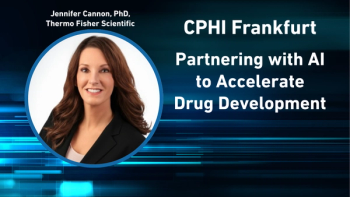
As Thermo Fisher’s Jennifer Cannon explains in this first part of a two-part interview, the collaboration is intended to help improve the speed and success of drug development.

Life sciences CEOs are boosting AI spending, focusing on workforce upskilling, and tackling ethical challenges to drive innovation and product development.
Advertisement
Advertisement
Trending on Pharmaceutical Technology
1
Pharma Leaders Weigh in On AI's Measurable Results In 2026
2
Formulation and Evaluation of a Sustainable Analgesic Cream Utilizing Renewable Bio-Based Ingredients and Green Chemistry Design Principles
3
Manufacturing Intelligence: How AI Poisoning Hides in Plain Sight
4
Why BMS, Roche, and LGM Pharma Outsourced Key Capabilities
5