|Articles|March 15, 2016
- Pharmaceutical Technology-03-15-2016
- Volume 2016 eBook
- Issue 1
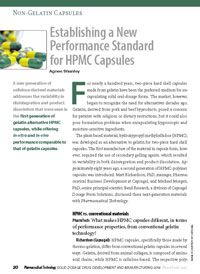
Establishing a New Performance Standard for HPMC Capsules
Author(s)Agnes Shanley
Matt Richardson of Capsugel and Michael Morgen of Bend Research, discuss improvements and results that have been seen in the second generation of hydroxypropyl methyl cellulose (HPMC) materials.
Advertisement
As alternatives to gelatin capsules are sought, plant-based alternatives are being improved to address variability issues. Matt Richardson of Capsugel and Michael Morgen of Bend Research, discuss improvements and results that have been seen in the second generation of hydroxypropyl methyl cellulose (HPMC) materials.
from Pharmaceutical Technology’s 2016 Solid Dosage Drug Development and Manufacturing eBook.
View other articles in the
Articles in this issue
over 10 years ago
Optimizing Tablet Compressionover 10 years ago
Excipient Quality and Selectionover 10 years ago
Filling the Analysis Gap in the Move to Continuous Processingover 10 years ago
Modeling and Simulation Move Downstreamover 10 years ago
Unifying Excipient DatabasesAdvertisement

Related to this article

The winners of the CPHI Pharma Awards 2026 include a neurodegeneration platform, a track-and-trace packaging innovation, a enzymatic mRNA manufacturing technology, and a cell-free enzymatic biomanufacturing platform.

Richard Jaenisch explains why NAMs are compressing drug development faster than AI and what FDA's new nonclinical testing rule means for sponsors.

Hovione's $35M CDC Flex line links spray drying to tablets, designed to eliminate scale-up under FDA Q13 guidance.

This week on PharmTech, Merck diversified its pipeline, USP emphasizes supply chain security, AI systems are examined, and speakers preview their presentations at CPHI Milan and AAPS PharmSci 360.

Ron Scarboro, Azurity Pharmaceuticals, claims drug reformulation that removes patient barriers must preserve efficacy, urging early cross-functional team alignment.

Novartis licenses Abogen's mRNA-encoded T-cell engager for autoimmune disease, raising scale-up questions for mRNA-lipid nanoparticle manufacturing.

Ron Scarboro, Azurity Pharmaceuticals, explains why real-world usability belongs at product definition and how post-launch feedback should guide drug formulation.
Advertisement
Advertisement