News|Articles|March 15, 2016
- Pharmaceutical Technology-03-15-2016
- Volume 2016 eBook
- Issue 1
Excipient Quality and Selection
Author(s)Irwin Silverstein, PhD
The author discusses key areas of focus and presents best practices from the International Pharmaceutical Excipients Council (IPEC).
Advertisement
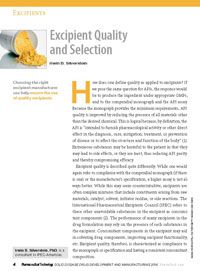
Defining quality for excipients may not be as clear cut as it is for APIs, but it is essential to product quality and patient safety, and to choosing the best supplier. The author discusses key areas of focus and presents best practices from the International Pharmaceutical Excipients Council (IPEC).
from Pharmaceutical Technology’s 2016 Solid Dosage Drug Development and Manufacturing eBook.
View other articles in the
.
Articles in this issue
over 10 years ago
Optimizing Tablet Compressionover 10 years ago
Filling the Analysis Gap in the Move to Continuous Processingover 10 years ago
Modeling and Simulation Move Downstreamover 10 years ago
Unifying Excipient Databasesover 10 years ago
Establishing a New Performance Standard for HPMC CapsulesAdvertisement

Related to this article

Bill Williams, AAPS, compares KinetiSol and spray drying for amorphous solid dispersions, covering 75% drug loading, pill burden, weakly basic drug release, and process limits.

Univar Solutions scientists developed a lidocaine cream built on starch, sorbitol, coconut oil, and beeswax that matched a commercial benchmark on viscosity, assay, and hydration.

The PharmTech team focused on its coverage of AAPS PharmSci 360 this week, conducting interviews with experts on a range of topics including formulation platforms, AI, amorphous solid dispersions, and animal studies.

The agreement between CDER and OII with allow for coordinated marketing application assessments and inspections.

Ron Filler, Drug Development Consultants, explains how USP's 1074 revision brings human-relevant safety science to formulators and excipient makers.

Ron Filler, Drug Development Consultants, explains how USP's 1074 revision brings human-relevant safety science to formulators and excipient makers.

Pauric Bannigan, Intrepid Labs, explains how physics-informed machine learning aids formulation and why regulators still want experimental data.
Advertisement
Advertisement
Trending on Pharmaceutical Technology
1
AI Formulation: Regulators Want Data
2
FDA’s New Inspection Playbook Counts Remote Assessments and MRA Reports Toward Facility Evaluations
3
USP 1074 Revises Excipient Safety: AAPS PharmSci 360 2026
4
Late-Phase Impurities Need Reference Standards: AAPS PharmSci 360 2026
5