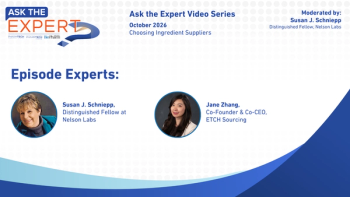
Jane Zhang of ETCH Sourcing explains why geopolitics, transparency, and partnership now weigh as heavily as cost and quality when companies choose suppliers, in this episode of Ask the Expert, moderated by Susan J. Schniepp of Nelson Labs.
In part 1 of this 2-part discussion, our panelists explain how to structure a tech transfer package, handle gaps in process understanding, and qualify analytical methods.
Technology transfer between sponsors and contract organizations is a crucial drug manufacturing stage that may be prone to errors. In a roundtable discussion, Katy MacLellan, technical team leader at Symbiosis; Lauren Nolan, senior director, Operations, Sterile Injectables at Kindeva; Yash Sabharwal, CEO and Co-Founder of QbDVision; and Judyta Suskiewicz, director Business Development, at Mabion, shared how they approach documentation, process understanding, and analytical method transfer to reduce risk and accelerate timelines.
Nolan structures tech transfer around three layers. The first is documentation: batch records, manufacturing instructions, specifications, and analytical methods. These items are non-negotiable baseline requirements. The second layer is process understanding—the "why" behind the process that documents alone rarely capture. A receiving site needs visibility into critical process parameters, acceptable operating ranges, historical deviations, and lessons learned to identify where true risk exists.
The third layer is operational knowledge: operator techniques, engineering judgment, campaign sequencing, equipment nuances, and practical troubleshooting. According to Nolan, this is where transfers succeed or fail, because these details are often absent from standard operating procedures. The goal, she said, isn't simply for a receiving site to execute a batch record, but for it to independently operate, troubleshoot, and improve the process with the same confidence as the sending site. In her experience, that level of comfort typically develops around the 8-month mark, with further gains coming through repetition.
Sabharwal argued that documents may not be the most effective vehicle for transferring this information at all. His company’s software platform digitizes product requirements, process definitions, ranges, risk, and control strategies into a shared digital framework that supports collaboration, rather than the traditional model of passing documents back and forth. Sabharwal noted that organizations adopting this approach are aiming to compress transfer execution timelines from roughly 8 months to 8 weeks.
When asked how to address gaps discovered mid-transfer, MacLellan described a case-by-case approach built around a cross-functional impact assessment to determine risk to product quality or facility operations. Depending on the outcome, the receiving site may request additional information from the client or further development work before accepting the drug substance.
Nolan emphasized reframing gaps as opportunities rather than failures: better to surface them during tech transfer than during commercial manufacturing. The first step is determining whether a gap reflects missing documentation or missing scientific understanding. If a critical process characterization genuinely hasn't been completed, the receiving site shouldn't be left to compensate; instead, both organizations should conduct a structured risk assessment to determine what additional engineering work, characterization, or validation is needed. She stressed transparency with the sponsor throughout, noting that hiding uncertainty only creates larger downstream problems; tech transfer should reduce uncertainty, not relocate it.
Suskiewicz echoed this collaborative framing, describing gaps as shared problems to de-risk and optimize together rather than shortcomings to assign blame for. She noted that identifying gaps as early as possible, ideally before execution begins at the receiving site, improves outcomes for the entire transfer.
On analytical method transfer, often a source of delay and failure, Sabharwal drew a parallel between analytical procedure definitions and manufacturing process definitions, noting they are architecturally similar. His company’s digital transfer tools can support analytical process and procedure definition, along with lifecycle management aligned to International Council for Harmonisation guidelines. That framework calls for clearly defining an analytical target profile (ATP), linking it back to product quality attributes, and then building a digital procedure best suited to meet that ATP.
Sabharwal framed the broader goal as proactive rather than reactive: using the information already available to identify gaps and problems before transfer execution begins, rather than troubleshooting analytical methods after they've already failed at the receiving site.
Click the video above to watch part 1 of the discussion.
Katy MacLellan is a Technical Team Leader at Symbiosis Pharmaceutical Services, a UK-based CDMO specializing in the GMP aseptic manufacture of injectable drug products for clinical and commercial supply.
In her role, Katy leads the technical delivery of client projects and supports the successful transfer of products into GMP manufacturing. She holds a master's degree in Chemistry and Drug Discovery from the University of Strathclyde and has gained international pharmaceutical manufacturing experience with Pfizer, Eli Lilly and CSL Seqirus before joining Symbiosis.
Katy has expertise across technology transfer, process validation and aseptic manufacturing operations, working closely with multidisciplinary teams to ensure projects progress efficiently from development through manufacture. She has a particular interest in process analytics, data-driven manufacturing and the application of emerging technologies to pharmaceutical development and production.
Lauren Nolan is senior director, Operations, Sterile Injectables at Kindeva.
Yash Sabharwal, PhD, is CEO and Co-Founder of QbDVision. Yash Sabharwal is an accomplished inventor, entrepreneur, and executive specializing in the funding and growth of early-stage technology companies focused on life science applications. He has started three companies and successfully exited his last two, bringing a wealth of strategic and tactical experience to the team.
Judyta Suskiewicz is director of Business Development at Mabion. As the Business Development Director at Mabion S.A., I leverage a strong scientific foundation in biotechnology and quality control to drive strategic growth and partnerships in the biologics sector. Focused on operational excellence and Lean management methodologies, I help partners seamlessly accelerate their biological products from development through to commercial manufacturing.