
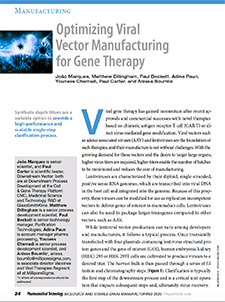

Bioprocessing advances improve product yield, cut costs, and streamline integration between upstream and downstream processes.
Bioprocessing advances improve product yield, cut costs, and streamline integration between upstream and downstream processes.

The new cell-line producing platform enables fully scalable production of high-performance adeno-associated virus vectors.
The goal of the collaboration is to manufacture up to one billion does per year of mRNA-1273, Moderna’s vaccine against the novel coronavirus.
Pharmaceutical Technology's In the Lab eNewsletter
Solentim and ATUM will bundle together the Leap-In Transposase platform with the VIPS single cell cloning instrument for cell line development.
Dutch company HALIX has announced it is joining a consortium of partners that are all under the guidance of the University of Oxford to provide good manufacturing practice (GMP) manufacturing services for a COVID-19 vaccine.
This milestone achievement will allow the companies to move forward with developing a GMP-compliant manufacturing process for clinical testing.
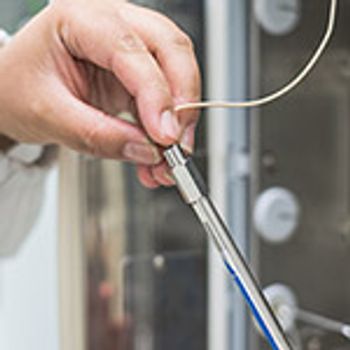
Advanced analytics and modeling can be used to predict downstream failures, allowing for corrective action before batches are lost.
The new patented process results in uniform, scalable production and the ability to deliver cell cargo similar to natural exosomes/extracellular vesicles.
Emergent BioSolutions will help develop and manufacture an oral vaccine candidate and will develop plasma-based antibody therapeutics.
The new BIOSTAT STR Generation 3 with BIOBRAIN bioproduction platform offers process intensification with automated feed and bleed and integrated cell retention functionality.
The technology enables the rapid production of large numbers of recombinant antibodies at 80-mL scale.
Tackling process development early on can better optimize manufacturing processes for emerging therapies.
The growing interest in developing cell and gene therapies has prompted industry investment to grow manufacturing capacity.
The expansion gives the company diversified capacity running cell production lines featuring Sartorius-brand 2000-L disposable bioreactors and now GE-brand 2000-L single-use bioreactors.
The company presented data on its G2 glycosylation studies at the 15th European Conference on Fungal Genetics in Rome on Feb. 19, 2020.
The company has said that all three of its operating sites in China started back up on Feb. 12 and that it is closely monitoring the outbreak.
The new facility includes six classified environment rooms with space to expand.
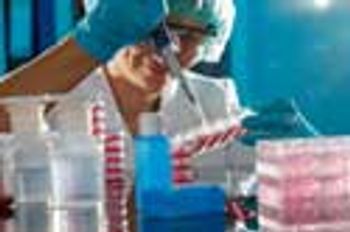
Contract partners must help innovators, especially smaller and virtual companies, consider manufacturability as early as possible in development. This requires focusing on technical and operational performance, as well as cost.
The need for manufacturing speed inspires contract manufacturers to explore advanced processing technologies.
The new facility, to be operated under the newly formed CDMO, The Center for Breakthrough Medicines, will be located in King of Prussia, PA, and will increase manufacturing capacity for cell and gene therapies.
The formation of the new gene therapy company stems from the progress and success of Nationwide Children’s Hospital’s clinical manufacturing and gene therapy work.
The next-generation gene editing system can be applied to the development of novel cell and gene therapies.
Equipment and Processing Report
Achieving effective manufacturing processes and sufficient capacity remains a top priority across a diversified biologic drug pipeline.
Sartorius and the German Research Center for Artificial Intelligence have established a research laboratory for AI in the biopharmaceutical industry.
The acquisition expands Charles River’s scientific capabilities in cell therapy development.