

Requirements for virus filtration must be considered in developing continuous downstream processes.
Requirements for virus filtration must be considered in developing continuous downstream processes.

Shortages of life-saving drugs are a regulatory and industry concern. Proper process development may help to ensure drug supply.

A new facility in California will expand Orchard Therapeutic’s capacity to develop and deliver lentiviral vector and gene-corrected hematopoetic stem cells.
The company will use GE Healthcare’s off-the-shelf KUBio biologics factory, which is expected to start operations in 2020, to provide development and manufacturing for early- to late-clinical and early-commercial manufacturing stages.
GSK and TESARO have entered into a definitive agreement concerning GSK's acquisition of TESARO for an aggregate cash consideration worth approximately $5.1 billion.
The investment builds on a collaboration the companies entered into in 2007 for various biomanufacturing projects.
FDA’s 21st Century goals can be realized by using a multi-purpose manufacturing facility with a flexible design that provides reliable production without extensive regulatory oversight.
GE’s new facility, which will be operational in 2019, will produce a fiber-based chromatography platform for more efficient biopharmaceutical purification.
Cobra, Pall, and Cell and Gene Therapy Catapult are collaborating to develop continuous manufacturing for gene therapy production.
The new center will integrate biologics drug discovery, development, clinical manufacturing, and commercial manufacturing.
The vaccine producer announced an expansion to its Holly Springs, NC, manufacturing facility where it will increase production of its cell-based quadrivalent influenza vaccine.
The new collaborative center aims to serve as a hub for innovations in drug development and manufacturing.
Under the new long-term agreement, Sartorius Stedim Biotech will continue to offer Lonza media and buffer products under non-exclusive terms.
Improving the manufacturing of gene therapy vectors will be crucial to making advanced treatments accessible to more patients who need them, agreed panelists at the 2018 Galien Forum.
Experts believe that the contract development and manufacturing organization market will reach $17.38 billion by 2022, with disruptive business models using Industrial Internet of Things (IIot) and single-use technologies proving more profitable and efficient in the long term.
The new program will provide cell and gene therapy companies a more efficient way to ensure quality compliance across collection center networks and to minimize quality system audit burden on these centers.
The expansion adds new capabilities and enhances existing service offerings for both oral and parenteral dosage forms.
The company has rolled out the first batch of TRACON Pharmaceutical’s lead product candidate from its Singapore-based single-use bioreactor.

A matrix of multi-functional cleanrooms can be adapted for launching products.
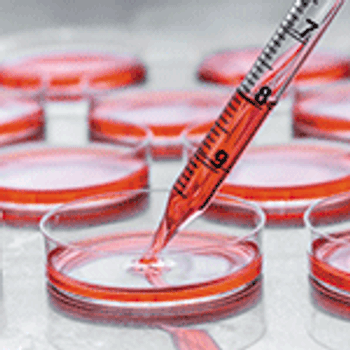
This article will explore the requirements for media and supplements needed to maintain newer cell lines, such as those based on human cells and fungal cells.
New data highlights ability of the SQZ cell therapy platform to preserve cellular functions.
A project funded by BioProNET will investigate optimization for bioprocessing of gene therapy vectors using hydrodynamic fluid flow fields.
A statement from FDA Commissioner Scott Gottlieb and Deputy Commissioner Anna Abram detailed FDA’s new plan to advance plant and animal biotechnology innovation.
The acquisition will allow Lonza to further develop technology for scalable autologous cell-therapy manufacturing.
The company will collaborate with GlycoBac to offer an insect cell line for the development of viral vaccines and gene therapies.