
Packaging and Distribution

Latest News


Dublin, OH (Nov. 14)-A half-year Cardinal Health study of radio-frequency identification (RFID) tags "under real-world conditions has demonstrated that the technology has real promise to provide an added layer of safety," according Renard Jackson, the company's vice-president and general manager of global packaging services, in a prepared statement.
i8_t-367097-1408681134577.jpg

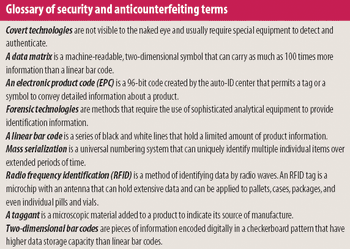
RFID is viewed by many, including FDA, as a technology with strong potential for carrying the mass serialization data needed to track and trace product and to create pedigree records.

i1-361496-1408684995448.jpg

Disappointed in progress thus far, the US Food and Drug Administration wants pharmaceutical manufacturers to make a greater effort to combat counterfeit products and recommends that they "move quickly" to implement radio-frequency identification technology.

The US Food and Drug Administration?s Counterfeit Drug Task Force (Rockville, MD, www.fda.gov) is recommending regulatory actions and the implementation of new technologies for reducing the risk of counterfeit drugs entering the United States. The group has followed up on its original 2004 report, in which it outlined the framework for protecting the public from counterfeit medicines, and an updated 2005 report with a third document encouraging electronic pedigrees, improved traceability in the drug supply chain, and the adoption of radio-frequency identification (RFID) tools.

i1-333031-1408688521794.jpg

The Fine Print

I always suspected that our purchasing manager had agreed to this just to save money . . .

i1-316157-1408682417641.jpg

Despite worries that industry is slow to adopt anticounterfeiting technologies, the 2006 Interphex program is rife with new methods for securing the supply chain.

The Pharmaceutical Industry has been slow in adopting radio frequency technology (RFID) to help control diversion and counterfeiting, according to a recent study by ABI Research (Oyster Bay, NY, www.abiresearch.com). In fact, only 10 drug products are expected to be shipped with RFID tags or smart chips embedded in the labeling in the coming year.

The type of robot used for placing and stacking the BFS cards is important. Conventional multi-axes designs have limited flexibility, often combined with high inertia that limits operating speeds.