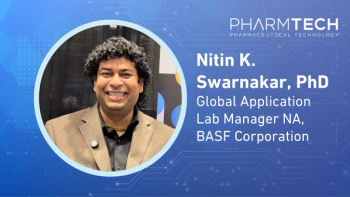
Nitin Kumar Swarnakar, PhD, global application lab manager at BASF in Tarrytown, spoke with PharmTech at AAPS PharmSci 360 about formulation and characterization challenges for amorphous solid dispersions.
Nitin Kumar Swarnakar, PhD, global application lab manager at BASF, talks about spray drying for drying amorphous solid dispersions and Raman spectroscopy’s role as a quantitative analytical tool.
At AAPS PharmSci 360 in New Orleans, which occurred from October 25-28, Nitin Kumar Swarnakar, PhD, global application lab manager at BASF, spoke with PharmTech about amorphous solid dispersions (ASDs), specifically in this part of the interview, he addresses process control in spray drying and what role Raman spectroscopy plays in analytics.
Formulation problems must be prevented rather than corrected, says Swarnakar. Once crystallinity or aggregation appears after spray drying, there is no way to go back and redevelop the formulation, he explains. The first lever is viscosity. With copovidone- and Soluplus (an excipient developed by BASF)-based systems, solids loadings of up to 40% are achievable in solvent while keeping viscosity low and solubility good. Hydroxypropyl methylcellulose (HPMC)-based approaches, by contrast, top out at about 5% in non-aqueous solvents and can turn cloudy, according to Swarnakar. For high-throughput spray drying, he says, the copovidone and Soluplus route is the better choice.
Beyond viscosity, he highlights nozzle selection, which shapes particle structure, along with spray rate and nitrogen flow as parameters that need close monitoring. Recent work on secondary vacuum drying showed that the vacuum level used in this post-spray-drying step influences how quickly residual solvent is removed, which in turn affects the stability and dissolution performance of the final ASD, says Swarnakar. This is especially important for high drug load formulations, he stresses.
On analytical methods, Swarnakar notes that any technique used in regulatory filings must be validated against known amorphous compounds at different levels of amorphicity and must be quantitative rather than qualitative. Raman spectroscopy is useful for this purpose, and BASF is working to advance it toward quantifying heterogeneity within ASDs. However, he cautions that the technique is not yet ready for full validation and quantification and will need time to mature.
Nitin Kumar Swarnakar, PhD, is global application lab manager at BASF in Tarrytown, New York. He holds BPharm, MPharm, and PhD degrees in pharmaceutical science, has worked with generic and innovator drug companies, and has been with BASF for 7 and a half years.