Terry Katz, CEO and cofounder of ForgeStop Technology Corporation, explains the company’s CPHI Award-winning connected product technology and how it helps to combat drug counterfeiting.
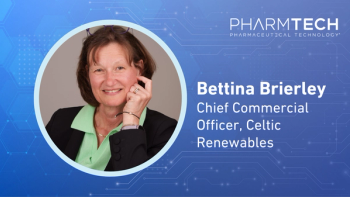
Celtic Renewables won the CPHI Award for Sustainable Pharma Excellence for its green chemicals used in pharmaceutical manufacturing. Bettina Brierley, chief commercial officer, talks about the adoption, capacity, and pricing of biosolvents.
Celtic Renewables, a biotechnology company, created a patented and scaled biorefining process to convert low-value waste that can be used by the pharmaceutical industry. PharmTech spoke with Bettina Brierley, chief commercial officer, about customer adoption, production capacity, pricing, and supply security for the company's biosolvents.
Adoption, she explains, is relatively straightforward because the company's bioacetone and biobutanol function as drop-in replacements for fossil-derived equivalents; therefore, customers do not need to clear an additional regulatory step. The single requirement from pharmaceutical buyers is a third-party verified life cycle analysis, delivered in a specific format known as PACT, which the industry uses to upload the data into its own systems. As long as the solvents meet pharmaceutical specifications, Brierley says, replacement is uncomplicated.
On scale, there is a gap between current output and market need, Brierley explains. Celtic Renewables currently produces around 500 tons of solvent annually, roughly 100 tons of bioacetone and 400 tons of biobutanol, which she describes as a drop in the ocean in the global solvent market. The first commercial plant will lift capacity to 10,000 tons. To put that in perspective, she notes that this volume would likely satisfy a single requirement of one large pharmaceutical company. The company would like to operate 10 such plants eventually, but Brierley acknowledges that will take time.
Pricing has moved toward realism, says Brierley. Early expectations of a steep premium reflected the high cost of manufacturing in a demonstrator plant. The company subsequently built a cost model around the first commercial plant and now prices on that basis.
On supply security, Brierley confirms customers will not be single sourced: once the commercial plant is running, the demonstrator plant remains in operation as a backup and as a testbed for new feedstocks. Feedstocks themselves are abundant; the next commercial plant would use roughly 5% of Scotland's available potato waste alone.
Bettina Brierley is chief commercial officer at Celtic Renewables. Bettina has more than 35 years' experience in the chemical industry, specializing in sales, business development and commercial roles. Having held senior roles at Hoechst AG, Clariant AG and Caldic UK, she has extensive leadership experience across international chemical markets and a track record of building partnerships and driving business performance. Bettina is passionate about advancing low-carbon, circular solutions for both future generations and the chemical industry.