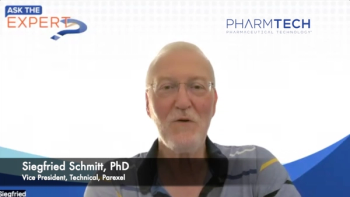
In this episode of Ask the Expert, Siegfried Schmitt, PhD, vice president, Technical at Parexel, and Susan J. Schniepp, distinguished fellow at Nelson Labs, discuss how companies should approach post-approval changes to their CMC regulatory filings.
Dirk Margosch, Vice President Visual Inspection, Assembly & Secondary Packaging at Vetter Pharma-Fertigung GmbH & Co KG, provides advice on how to respond to defective vials in a batch and how to prevent future problems in secondary packaging.
In this episode of Ask the Expert, Dirk Margosch, Vice President Visual Inspection, Assembly & Secondary Packaging at Vetter Pharma-Fertigung GmbH & Co KG, addresses steps that can be taken to mitigate risk in future batches of vials during secondary packaging after defective units have been found during an inspection. A thorough investigation should be performed to discover the root cause of the defects to prevent future occurrences.
“This [investigation] should involve reviewing all processes related to production. That means aseptic filling, visual inspection, assembly and secondary packaging, of course, always including the relevant packaging components. And then second, define the right preventive action, if the investigation comes, for example, to the conclusion that the defective vials were already present after the filling,” says Margosch.
Click the video above to watch Dr. Margosch answer the following question:
“My company recently had critical incidental findings in several vials during secondary packaging. What can be done to minimize the risk of future market batches containing defective units?”
Dr. Dirk Margosch is Vice President Visual Inspection, Assembly & Secondary Packaging at Vetter, a global CDMO specializing in aseptic filling and packaging of injection systems. Margosch holds a degree in food science. He joined Vetter more than 15 year ago and has held various positions in the field of visual inspection and packaging.
Dr. Margosch joined the pharmaceutical service provider Vetter Pharma-Fertigung GmbH & Co KG in 2008 as head of production overseeing process implementation, product-specific qualification and operation of automated visual inspection systems, until he was given the opportunity to manage the entire visual inspection department including both, manual and automated visual inspection. Since 2021, he has been responsible for non-aseptic production, which encompasses automated and manual visual inspection, assembly, and secondary packaging.
Welcome to the Ask the Expert video series. This series is an extension of the PharmTech Group’s long-running print column in which industry experts answer common quality and regulatory questions from the industry. This new video series will expand on topic areas to include development and manufacturing concerns to help those working in the industry better understand bio/pharmaceutical requirements. Have a question you would like answered? Send it to
We hope you enjoy the discussion!