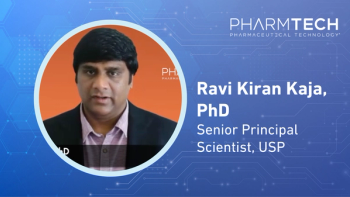
Ravi Kiran Kaja, PhD, explains how USP’s industry-wide initiative aims to build confidence in trace-level extractables and leachables results.
Ronald Piervincenzi, USP, explains why drug supply resilience needs a system approach, from procurement benchmarks to regulatory capacity building.
In part 3, of a 3-part interview with PharmTech, Ronald T. Piervincenzi, CEO, of US Pharmacopeia (USP), argues that no single manufacturer or purchaser can solve drug supply resilience alone.
Piervincenzi illustrates the point with a drug supplied roughly equally by two manufacturers. One invests in alternative sourcing of starting materials, modest stockpiles, and a quality-controlled distribution system. The other competes on low price without those safeguards. If the low-cost supplier has a significant quality failure, the resulting shortage reaches every purchaser, including those buying from the resilient company, because remaining supply must be distributed for humanitarian reasons. "It isn't enough to have one medicine supplier be resilient, and therefore, no one player or even one procurer of medicine can ensure a robust supply," he says.
Piervincenzi describes this as a collective action challenge: buyers hesitate to pay for reliability they cannot secure on their own. To address it, USP is developing benchmarks that help procurers reward resilience and reliability, with the goal of shaping private and potentially public procurement policy, and he reports growing support from high-quality manufacturers. The effort comes as USP's annual drug shortages report finds that shortages are lasting longer even
Piervincenzi also links resilience to regulatory capacity. As more regulators mature, complexity rises for multinational manufacturers. "Clearly, and as far as I know, no one has asked for the most stringent regulators to reduce their standards to match those who are just starting to build their regulatory system." Instead, he says, lifting emerging systems toward international standards, as Latin America has done over 20 years, broadens the sourcing base available for US nearshoring strategies. USP has supported regulatory capacity building for 35 years across Latin America, Southeast Asia, and Africa. "They know us for our standards and our medicine quality work, but that regulatory system development work that we've done has been, honestly equally important," he says.