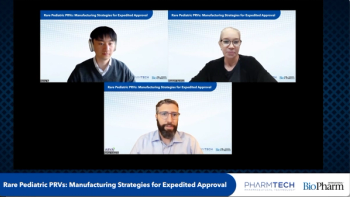
Nate Edwards of Arya Consulting moderates a discussion with Elisabeth Gardiner of Tevard Biosciences and Donny Xu of the RTW Institute about the regulatory and manufacturing hurdles facing rare disease drug developers.
Webinar Date/Time: Fri, Sep 25, 2026 11:00 AM EDT
High-concentration biologics are forcing a reckoning across formulation, device design, and fill-finish, where a single threshold in viscosity or injection force can turn a promising molecule into a manufacturing nightmare. Join industry experts with direct experience in this area as they unpack the hidden thresholds, cross-disciplinary trade-offs, and what it really takes to get a high-concentration biologic from the bench into a patient's hands.
Register Free:
Event Overview:
High-concentration biologics are pushing the limits of what can be formulated, filled, and delivered as a low-volume subcutaneous injection, forcing tighter coordination across formulation science, device engineering, and CDMO fill-finish operations than ever before. As more pipeline candidates require concentrated, small-volume presentations to support at-home or self-administered dosing, professionals across this value chain are contending with viscosity, stability, and injectability constraints that can make or break a program's manufacturability.
This conversation brings together experts spanning formulation, device design, and fill-finish to unpack where these challenges actually bite, whether there are hard thresholds that change everything once crossed, and how decisions made early — often in a different discipline entirely — can quietly constrain what's possible downstream. Getting this right determines whether patients can self-administer a therapy at home instead of requiring an infusion visit, directly shaping treatment burden and access. As the industry leans further into high-concentration, low-volume formulations, understanding today's bottlenecks and where the field is headed over the next three to five years is essential for anyone working across CMC, device, and manufacturing functions.
Key Learning Objectives
Who Should Attend
This Drug Digest episode is best suited for professionals directly involved in formulation and development of large molecules, especially:
Speakers:
Flora Felsovalyi, PhD
Head of Pharmaceutical Services,
Lonza Integrated Biologics
Serves as Head of Pharmaceutical Services for Integrated Biologics at Lonza. She brings over 20 years of experience leading combination product development in the medical device and pharmaceutical industries, specializing in parenteral drug delivery. In this role, she leads a team responsible for developing and offering device-related services to customers, as well as non-GMP manufacturing of prefilled syringes.
Mary Evelyn Hudson
Director, Business Development,
Lifecore Biomedical
A business development leader in the pharmaceutical and biotechnology industry with extensive experience in CDMO solutions, strategic partnerships, and technical operations. Throughout her career, Mary Evelyn has held leadership roles spanning business development, validation, quality systems, and technical services at organizations including Woodstock Sterile Solutions, DPT Laboratories, Wockhardt, Mallinckrodt Pharmaceuticals, Bayer HealthCare, and Baxter Healthcare.
Ryan Swanson, PhD
Director, Process Development, Lifecore Biomedical
Through his current position at Lifecore and more than five years at Bristol-Myers Squibb, Ryan Swanson has more than 13 years of industry experience working on a wide range of projects (early- and late-stage, commercial, injectables, medical device, combination, topicals) for a variety of products (biologics, small molecule, polymers, peptides, hydrogels, suspensions/emulsions, ADC) across multiple subject areas (process development, GMP manufacturing, tech transfer, scale-up, analytical development, raw materials).
Uday Harle, PhD
CEO, Shilpa Biologicals Private Limited
A PhD in pharmaceutical sciences with 24 years of techno-commercial experience, the majority in biological development. Over 14 years, Dr. Harle served in leadership as Head at Abbott, assistant VP at Amneal Biologics USA, and Head at Ferring global R&D center, during which he enabled many BLAs/marketing authorizations with the FDA and filed many INDs for biosimilars and novel biologics. He has also led end-to-end development of many biologics, generics, and CAR-T therapies with large commercial global portfolios and successfully registered multi-million-dollar oncology and specialty products across the FDA, EMA, MHRA, Health Canada, ANVISA, and CDSCO.
Benjamin Gilston, PhD
Senior Scientist, KBI Biopharma
Benjamin Gilston, PhD, is a senior scientist at KBI Biopharma, where he supports analytical and formulation sciences for biopharmaceutical development. With a background in biochemistry and structural biology, he brings extensive experience in protein characterization and analytical development. Gilston earned his PhD from Northwestern University and completed postdoctoral research at Northwestern and Vanderbilt University.
Register Free: