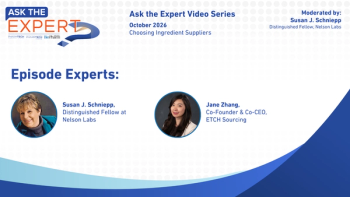
Jane Zhang of ETCH Sourcing explains why geopolitics, transparency, and partnership now weigh as heavily as cost and quality when companies choose suppliers, in this episode of Ask the Expert, moderated by Susan J. Schniepp of Nelson Labs.
PharmTech spoke with Dr. Hui-Yin (Harry) Li, president and CEO of Wilmington PharmaTech, about steps that should be taken to build a productive relationship between sponsor and contract organizations.
The pharmaceutical timeline from discovery to market is a long, complex process. Sponsor companies often use contract organizations, such as contract manufacturing organizations (CMOs), to perform the bulk of the manufacturing processes. Because the sponsor companies, in the eyes of regulators, have the ultimate responsibility to ensure the safety, quality, and efficacy of drug products, maintaining a healthy relationship with CMOs that includes oversight is imperative.1,2
But how is this relationship created and maintained in a way that benefits both sponsor and contractor? PharmTech spoke with Hui-Yin (Harry) Li, PhD, president and CEO of Wilmington PharmaTech, to understand how these relationships are built and nourished.
Li: A strong sponsor–CMO relationship starts with a well-defined quality agreement that clearly assigns responsibilities for good manufacturing practice (GMP) compliance, quality systems, change control, deviations, investigations, corrective actions and preventive actions (CAPA), regulatory communications, audits, and product release. The agreement should be developed collaboratively and aligned with the commercial contract, technology transfer plan, and regulatory strategy.
Quality agreements typically receive substantial attention during contract negotiations, while governance structures often receive less. In my experience, more challenges arise from unclear communication pathways, decision-making authority, or escalation processes than from the agreement wording.
A quality agreement sets the foundation. Effective governance is what keeps the relationship aligned throughout the program. Strong partnerships establish a tiered structure from the outset with executive sponsors, operational project teams, and quality representatives. Regular joint meetings, defined escalation pathways, and clear decision-making responsibilities keep both parties aligned. Early agreement on communication expectations, risk tolerance, timelines, and success criteria prevents misunderstandings later on.
Transparency is built through consistent communication long before a problem occurs. For active development or manufacturing programs, weekly operational meetings and monthly management reviews are often effective. These meetings should cover project status, manufacturing schedules, quality metrics, change controls, supply chain risks, and upcoming milestones.
When deviations, investigations, or supply disruptions occur, timely communication matters even more. In my experience, sponsors rarely get upset because a deviation occurred; they get upset when they learn about it late. Most sponsors understand that manufacturing is complex and issues can happen. What they expect is prompt notification, transparency, and a credible resolution plan. Sharing data, root cause analyses, risk assessments, and CAPA plans maintains trust and facilitates collaborative problem-solving. Sponsors are far more understanding when informed promptly and involved appropriately, rather than learning about issues after significant delays.
The most productive sponsor–CMO relationships focus oversight on outcomes, compliance, and risk management rather than day-to-day operations. Sponsors should recognize that CMOs have established quality systems, manufacturing expertise, and operational processes that support multiple clients and regulatory requirements.
A common challenge arises when sponsors manage individual manufacturing activities rather than focusing on process performance, quality outcomes, and key risks. The CMO was selected for its expertise, which should be leveraged while maintaining appropriate visibility into quality, compliance, and program risks. The most effective relationships allow the CMO to execute within its established quality systems and operating procedures while providing sponsors with the oversight they need.
A balanced approach includes regular technical review meetings, periodic quality reviews, milestone-based decision points, and clearly defined escalation procedures. Joint steering committees or technical review boards work well for complex programs because they provide a structured forum for discussing process performance, technology transfer progress, quality trends, and strategic decisions. Clear expectations for what information is shared, when, and who has decision-making authority prevent micromanagement while ensuring appropriate oversight. When both parties approach discussions as partners, oversight becomes collaborative rather than adversarial.
Contracts establish expectations, but long-term success is usually driven by relationships and mutual business value. Multiyear programs, predictable forecasting, transparent planning, and credible opportunities for future work give CMOs strong incentives to invest resources and attention in a sponsor's products.
From a CMO’s perspective, one of the strongest motivators is visibility into a sponsor's long-term plans. When sponsors share realistic forecasts, future development opportunities, and commercial expectations, CMOs are more willing to invest resources, dedicate technical expertise, and proactively support the program's success.
The strongest long-term relationships are those where the sponsor views the CMO as a strategic partner rather than simply a vendor. Sponsors that share long-term product plans, involve the CMO in technical discussions, and recognize its contributions often receive greater engagement and commitment. Sustaining motivation over multiple years requires open communication, fair resolution of challenges, realistic expectations, and a shared focus on patient outcomes and commercial success. When both organizations treat the relationship as a mutual benefit partnership, priorities naturally align. When every project is treated as a standalone transaction, it becomes much harder for either side to make the long-term investments that drive operational excellence and continuous improvement.
Continuous improvement succeeds when quality is a shared responsibility, not just a contractual obligation. Even for well-established late-stage and commercial products, there’s always room to improve execution, reliability, and operational efficiency. Sponsors and CMOs should routinely review process performance, manufacturing trends, deviations, investigations, and operational metrics to improve robustness and reduce risk while maintaining regulatory compliance.
Some of the most valuable improvements come from joint reviews after manufacturing campaigns are completed. Beyond deviations, sponsors and CMOs can review metrics such as yield, cycle time, equipment utilization, right-first-time performance, and recurring operational challenges. These discussions often identify opportunities to improve manufacturing consistency, strengthen supply reliability, and reduce operational risk without changing the underlying manufacturing process.
The strong sponsor-CMO relationships formalize these discussions through periodic business reviews, technical reviews, and lessons-learned sessions. When both organizations share common goals around quality, reliability, supply continuity, and operational excellence, continuous improvement becomes part of the partnership rather than simply a compliance exercise. The result is a more reliable manufacturing operation that consistently delivers high-quality product to patients.
Dr. Hui-Yin (Harry) Li has more than 30 years of combined experience in all aspects of new drug research and development, including current GMP (CGMP) API manufacturing, solid-state chemistry, and project management. He is the author of numerous patents and publications, including key process and polymorph patents related to several important pharmaceutical compounds. In 2003, Li founded Wilmington PharmaTech with 3 CGMP production facilities, an R&D center in Newark, Delaware, and a research center in Suzhou, China, and he continues to serve as president and CEO. Li received a BS in chemistry from Nanjing University of Science and Technology, an MS in natural product chemistry from Shanghai Institute of Materia Medica, Chinese Academy of Sciences, and a PhD in organic chemistry from Tokyo Institute of Technology. From 1990 to 1991, he was a postdoctoral fellow in the Medical Products Department at DuPont. After working as a medicinal chemist with DuPont Merck Pharmaceuticals from 1991 to 1995, he worked as a process chemist in the Process R&D department at DuPont Pharmaceuticals Company (1995-2001) and at Bristol Myers Squibb (2001 to 2002). Li is also an adjunct professor at the University of Delaware and at the Shanghai Institute of Materia Medica, Chinese Academy of Sciences in China.
17 days ago
Proving Control, Not Assuming It17 days ago
Complying with International Pharmacopoeias2 months ago
How AI Can Assist With Postmarketing Changes