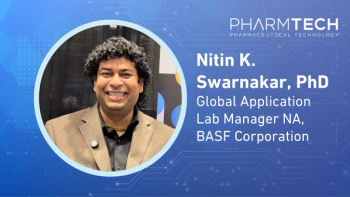
Nitin Kumar Swarnakar, PhD, global application lab manager at BASF, talks about spray drying for drying amorphous solid dispersions and Raman spectroscopy’s role as a quantitative analytical tool.
Subathra Ramamoorthy, Veranova, on when to escalate to structural elucidation and pair orthogonal techniques when characterizing an impurity.
At AAPS PharmSci 360 in New Orleans, which occurred from October 25-28, PharmTech connected with Subathra Ramamoorthy, MS, RPh, associate principal scientist in analytical R&D, Veranova, who explained how to scale impurity work to each development phase.
Ramamoorthy stresses that a phase-appropriate approach doesn't mean cutting scientific corners. “It is about doing the right amount of science at the right time,” Ramamoorthy says.
Early development focuses on understanding the impurity profile and building methods. By Phase 2, as the process is optimized, a stubborn impurity calls for structural elucidation. By Phase 3, any impurity above the identification threshold needs complete elucidation backed by a qualified reference standard. Ramamoorthy also names other triggers:
For an unknown organic impurity, Ramamoorthy starts with liquid chromatography with photodiode array detection or gas chromatography. From there the work moves to high-resolution mass spectrometry, which gives accurate mass, isotope patterns, and fragmentation patterns. Later phases may bring in nuclear magnetic resonance, inductively coupled plasma mass spectrometry for elemental impurities, and X-ray powder diffraction and thermal analysis for solid-state characterization.
Ramamoorthy cautions against investing too much while the process is still changing, but warns that