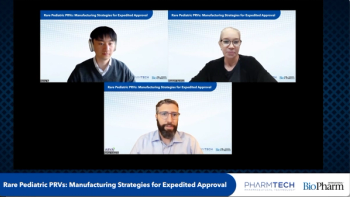
Nate Edwards of Arya Consulting moderates a discussion with Elisabeth Gardiner of Tevard Biosciences and Donny Xu of the RTW Institute about the regulatory and manufacturing hurdles facing rare disease drug developers.
Ocrelizumab biosimilar for multiple sclerosis: Teva and Polpharma Biologics sign global deal covering intravenous and subcutaneous forms.
On July 9, 2026, Teva Pharmaceutical Industries and Polpharma Biologics International have entered a global licensing agreement covering a proposed biosimilar to Ocrevus (ocrelizumab), a biologic used to treat multiple sclerosis.1 The agreement grants Teva exclusive rights to commercialize both the intravenous and subcutaneous formulations of the biosimilar candidate, contingent on regulatory approval in each market where it is introduced.
Ocrelizumab is a humanized monoclonal antibody designed to target immune cells believed to play a role in the autoimmune activity associated with multiple sclerosis.1 The reference product, Ocrevus, is approved for relapsing forms of multiple sclerosis and primary progressive multiple sclerosis. In the United States, the intravenous version is sold as Ocrevus, while the subcutaneous version is marketed separately as Ocrevus Zunovo. In the European Union, both formulations carry the Ocrevus name.
Under the terms of the agreement, Polpharma Biologics retains full responsibility for developing and manufacturing the biosimilar candidate, working with outside development and manufacturing partners.1 Teva will handle regulatory submissions and, if the product is approved, its commercialization in the US, Europe, Brazil, Canada, Australia, New Zealand, Israel, and Turkey.
Multiple sclerosis is a chronic, progressive disease of the central nervous system in which the loss of myelin disrupts the transmission of nerve signals, producing symptoms such as fatigue, walking difficulty, spasticity, dizziness, and vision problems.1 Biologic therapies like ocrelizumab have become central to managing the disease, but their cost and manufacturing complexity keep barriers to access high. A biosimilar that reaches the market could ease some of that pressure once patent and regulatory exclusivities allow entry.
The arrangement also illustrates how biosimilar programs come together: one company focuses on cell line development, process design, and quality assurance, while a partner contributes regulatory expertise and commercial infrastructure.1 This division lets a specialized biologics developer concentrate on matching a reference product's structure and function, while a larger pharmaceutical company applies its established relationships with regulators and health systems across regions. The subcutaneous formulation adds further complexity, because it typically requires reformulation and device development beyond what an intravenous product demands.
Teva has described the agreement as part of its Pivot to Growth strategy, under which the company is expanding its biosimilars portfolio through partnerships rather than relying solely on in-house development.1 “This agreement is aligned with Teva's Pivot to Growth strategy and our focus on expanding our biosimilars pipeline. With our global commercial footprint and deep expertise in complex medicines, we are well positioned to help bring this biosimilar candidate to patients,” said Yolanda Tibbe, vice president and Global Head of Biosimilars, Teva, in a press release.1
No financial terms of the agreement were disclosed, and no timeline for regulatory review or potential launch was provided.1 As with other biosimilars in development, the candidate's path to market will depend on generating analytical and clinical data that demonstrate it matches the reference product in structure, function, safety, and effectiveness, the standard regulators require before granting approval.
The Ocrevus biosimilar candidate joins a crowded field; industry trackers now count more than 60 companies and 75 drugs across the multiple sclerosis competitive landscape, spanning marketed therapies, pipeline programs, and inactive projects.2 Polpharma Biologics brings prior experience to this space: the company also developed Tyruko, a biosimilar to natalizumab that became the first biosimilar approved in the US for relapsing forms of multiple sclerosis, commercialized through a separate partnership with Sandoz, a division of Novartis. That precedent suggests a similar regulatory and commercial path may be possible for the ocrelizumab candidate, though clinical review will ultimately decide the outcome.
References