
ePT--the Electronic Newsletter of Pharmaceutical Technology
The Senate confirmed late Monday night Dr. Margaret A. Hamburg, 53, to lead the US Food and Drug Administration.
Angie Drakulich was editorial director of Pharmaceutical Technology.
ePT--the Electronic Newsletter of Pharmaceutical Technology
The Senate confirmed late Monday night Dr. Margaret A. Hamburg, 53, to lead the US Food and Drug Administration.
ePT--the Electronic Newsletter of Pharmaceutical Technology
The European Medicines Agency (EMEA) recently issued for public comment draft procedures on the evaluation of advanced therapy medicinal product (ATMPs).
ePT--the Electronic Newsletter of Pharmaceutical Technology
The first project report on FDA's Sentinel website, discusses the evaluation of existing methods for safety signal identification.
Covance talks about the risks, challenges, and tests required to develop a pandemic vaccine.
ePT--the Electronic Newsletter of Pharmaceutical Technology
The US Food and Drug Administration issued a draft guidance for industry, Label Comprehension Studies for Nonprescription Drug Products, in the May 1 Federal Register.
ePT--the Electronic Newsletter of Pharmaceutical Technology
Global market research firm IMS Health issued a disappointing report last week regarding the state of the pharmaceutical market.
ePT--the Electronic Newsletter of Pharmaceutical Technology
The US Food and Drug Administration has agreed to address some core industry questions regarding the changes made to US Pharmacopeia General Chapter <467> in July 2008.
ePT--the Electronic Newsletter of Pharmaceutical Technology
The US Food and Drug Administration issued a draft guidance for industry on the Submission of Summary Bioequivalence Data for Abbreviated New Drug Applications (ANDAs).
ePT--the Electronic Newsletter of Pharmaceutical Technology
In late March, the US Food and Drug Administration sent warning letters to nine companies to stop manufacturing 14 unapproved narcotic drugs. Less than two weeks later, on Apr. 9, the agency amended those letters when it realized that one particular unapproved opioid (a high concentrate of morphine sulfate oral solution) is desperately needed by patients.
ePT--the Electronic Newsletter of Pharmaceutical Technology
The US Food and Drug Administration issued 14 untitled letters last week to pharmaceutical companies in violation of the Federal, Food, Drug, and Cosmetic Act for publishing misleading and misbranded information about their drug products online.
ePT--the Electronic Newsletter of Pharmaceutical Technology
The United Kingdom's Medicines and Healthcare products Regulatory Agency (MHRA) seized nearly half a million pounds worth of counterfeit medicines on Mar. 26, 2009 in Middlesbrough, England, according to a MHRA press release.
ePT--the Electronic Newsletter of Pharmaceutical Technology
President Obama's plan for increasing drug comparative effectiveness research is moving forward. The 15 members of the Federal Coordinating Council for Comparative Effectiveness Research, created to manage the $1.1 billion allocation designated for the research in Obama's American Recovery and Reinvestment Act of 2009, were named last week, according to a Mar. 19 press release from the US Department of Health and Human Services
ePT--the Electronic Newsletter of Pharmaceutical Technology
President Barack Obama signed the fiscal year 2009 Ombnibus Appropriations Act on Mar. 11, 2009, giving the US Food and Drug Administration $2.6 billion. The funding can be used through the end of the fiscal year, Sept. 30, 2009.
ePT--the Electronic Newsletter of Pharmaceutical Technology
Senators Byron Dorgan (D-ND), Olympia Snow (R-ME), John McCain (R-AZ), and Debbit Stabenow (D-MI) introduced a bill March 4 that would allow pharmacists and wholesalers to import prescription drugs from Australia, New Zealand, Japan, Switzerland and the European Union.
ePT--the Electronic Newsletter of Pharmaceutical Technology
President Obama's Fiscal Year 2010 (FY 2010) budget includes support for a regulatory pathway for follow-on biologics.
Pharmaceutical Technology Europe
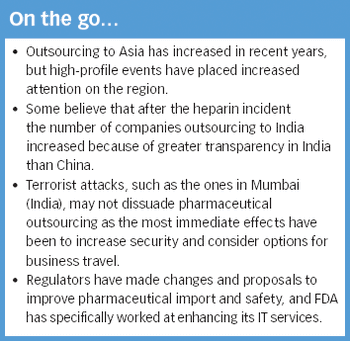
After a year of increased attention on the pharmaceutical supply chain in Asia, what will be the region?s short? and long?term role?
ePT--the Electronic Newsletter of Pharmaceutical Technology
Earlier this week, House Appropriations Committee Chairman Rep. David Obey (D-WI) introduced the FY 2009 Omnibus Appropriations Act (H.R. 1105).
ePT--the Electronic Newsletter of Pharmaceutical Technology
The US Food and Drug and Administration and the International Serious Adverse Event Consortium (SAEC) released last week the first data on certain types of genetic-based adverse drug events.
ePT--the Electronic Newsletter of Pharmaceutical Technology
Congress and health policy groups have been pushing for and debating the merits of comparative effectiveness studies for years. Now, the freshly signed 2009 economic stimulus bill devotes $1.1 billion of the total $787 billion plan to this type of research.
ePT--the Electronic Newsletter of Pharmaceutical Technology
The US Food and Drug Administration withdrew this week its direct final rule on Reporting Information About Authorized Generic Drugs.
ePT--the Electronic Newsletter of Pharmaceutical Technology
Taro Pharmaceuticals received a warning letter from the US Food and Drug Administration last week regarding its Brampton, Ontario, manufacturing facility.
ePT--the Electronic Newsletter of Pharmaceutical Technology
The United States Pharmacopeial (USP) Convention is pursuing greater collaboration with the US Department of Health and Human Services (HHS), and specifically, the US Food and Drug Administration.
ePT--the Electronic Newsletter of Pharmaceutical Technology
Former Senate Majority Leader Tom Daschle withdrew his name from consideration for US Secretary of Health and Human Services (HHS).
ePT--the Electronic Newsletter of Pharmaceutical Technology
The American Society for Quality (ASQ), a membership organization that focuses on quality training in several industries including pharmaceuticals and healthcare, has adopted a new certification for good manufacturing practice (GMP) professionals.
ePT--the Electronic Newsletter of Pharmaceutical Technology
Last week, the US Food and Drug Administration issued a draft guidance for industry, Standards for Securing the Drug Supply Chain–Standardized Numerical Identification for Prescription Drug Packages, and launched a pilot program to help protect the pharmaceutical supply chain.
ePT--the Electronic Newsletter of Pharmaceutical Technology
A December report on healthcare from the Congressional Budget Office (CBO) proposes that an abbreviated regulatory process for follow-on biologics could result in more than $10 billion in savings by the year 2020.
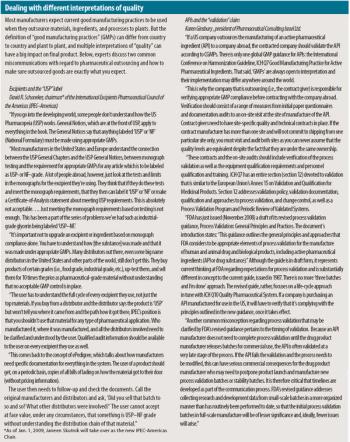
After a year of increased attention on the pharmaceutical supply chain in Asia, what will be the region's short- and long-term role? This article contains bonus online-exclusive material.
ePT--the Electronic Newsletter of Pharmaceutical Technology
A newly released study from the US Food and Drug Administration demonstrates that the printed information retail pharmacies provide to patients regarding medication use and risk of their prescriptions is not easy to read or understand.
ePT--the Electronic Newsletter of Pharmaceutical Technology
A US Food and Drug Administration guidance issued Tuesday provides new recommendations to applicants who wish to designate proposed products as orally disintegrating tablets (ODTs).
ePT--the Electronic Newsletter of Pharmaceutical Technology
The European Commission issued proposals last week to improve Europe's pharmaceutical market and patient safety.