

Buyers strategically target chemistry, manufacturing, and controls development services.

Jim Miller is president of PharmSource Information Services, Inc., and publisher of Bio/Pharmaceutical Outsourcing Report.
Buyers strategically target chemistry, manufacturing, and controls development services.

Recent deals suggest companies are willing to pay up to get into CMC services.

Pharmaceutical companies are seeing the development process in a new way, and that has major implications for service providers.

CMOs face market realities and exit some businesses.

The big question for pharmaceutical services providers coming into 2006 is: will the good times continue to roll?
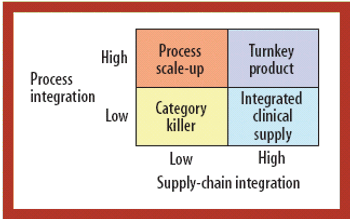
CROs and CMOs are pursuing new strategies to win a larger share of the burgeoning early development pipeline.

As major pharmaceutical companies take initial steps to prune their supplier base and negotiate better pricing, nonpharmaceutical companies that took those measures 10 years ago are moving to next-generation sourcing strategies. In designing those plans, these front-runners are applying two key lessons learned in recent years: supplier consolidation often doesn't go far enough, whereas price cutting can go too far.

Growth is critical to a strong company, and not only because it generates economies of scale.

A summertime burst of acquisition activity in CMC development services prompts the question: a coincidence of timing or the start of a trend?

The pharmaceutical outsourcing industry is well into its second year of very strong growth, and indications appear that it will enjoy a healthy third year as well.
2005 has been a good year for the contract services industry, and 2006 promises to be nearly as successful, according to the 2005 PharmSource–Pharmaceutical Technology outsourcing survey. But as pharmaceutical outsourcing activity grows, companies are looking for more sophisticated ways to manage and control their contract services expenditures.

Singapore is competing aggressively with India and China for a piece of the Asian sourcing business.

The Chapter 11 bankruptcy filing of aaiPharma (Wilmington, NC, www.aaipharma.com), parent of AAI Development Services, was the culmination of an agonizing year-long odyssey. It also was a first step in restoring one of the best-known brands in the CRO industry.
Major pharmaceutical companies are focusing more than ever on the prices CROs are charging for their services.
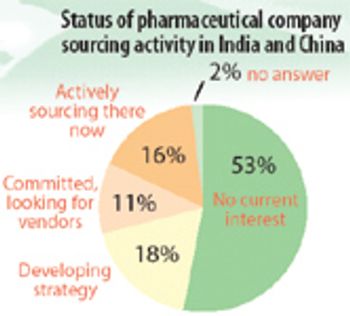
Achieving the promised benefits of offshore sourcing to India and China is more complicated than it seems.
After a five-year downturn, cautious optimism is taking hold among API manufacturers.
Too many players and threats to the main customer base challenge European dose manufacturers.
Patheon is betting the whole is worth more than the sum of the parts in its acquisition of Puerto Rico contract manufacturer Mova.
The blockage in the new product pipeline may be breaking. CROs report increased demand for late-stage development services in their latest round of earnings reports.
What should pharmaceutical companies make of recent corporate developments at several high-profile service providers?
Big Pharma is ramping up capital spending in parenteral manufacturing at the same time that contract manufacturers are completing their own major investment programs.
Early development services continue to be a sweet spot for contract R&D services. The big question is how soon the impact of early-development candidates will be felt in late development and commercialization.
The contract services industry is fertile ground for the investment banking community this summer.
Data from the 2004 Outsourcing Survey indicate that pharmaceutical companies are spending more on outsourced drug development, but with fewer suppliers.
Despite investors' strong interest in the chemical industry overall, pharmaceutical chemical businesses have not experienced much attention from investors thus far.
It's not clear whether contract service providers can deliver the performance improvements and costs savings that drug companies expect from large, long-term, semi-exclusive contracts.
Sponsors who have been lax in performing financial due diligence on their contractors have been given a wake-up call by the recent developments at aaiPharma.
Recent events in the pharmaceutical outsourcing industry highlight the importance of ongoing attention to contractors' financial situations and their strategic intent.
As outsourcing services become a more integral part of pharmaceutical processes, drug companies are taking a harder line on consequential.
The changing fundamentals of the industry are causing Big Pharma to focus more on operating efficiency instead of just product performance.