





Manufacturing
Latest News
Advertisement
Review of SUT Adoption in Biopharma Manufacturing
The evolution of therapeutic modalities drives the adoption of single-use technologies.

Why Are Pharmaceutical Companies Reluctant to Adopt Cloud Technologies?
Despite its understandable hesitancy, the pharma industry is facing a need for more widespread adoption of cloud-based solutions.

Automating the Future of Fill/Finish
Given the criticality of fill/finish processes, it is clear that automation is the next technological step.

Latest Videos






Shorts

0:29
Why Biologics Are High-Risk to Manufacture
3 months ago
by
Robert Dream(+1 more)

0:20
How Real-Time Data Prevents Micromanagement
3 months ago
by
Judyta Suskiewicz(+1 more)

0:24
The Trap of Robust AI Training with No End Goal
3 months ago
by
Richard Jaenisch(+2 more)

0:18
Defined Escalation Paths Build Client Trust
3 months ago
by
Katy MacLellan(+1 more)

0:18
Regulatory Authorities are Becoming Data-Driven
3 months ago
by
Jason Bock(+1 more)

0:24
The Most Expensive Unsolved Problem in Pharma
3 months ago
by
Megha Sinha(+1 more)
0:26
Why Traditional Pharma Supply Chains Fail Personalized Therapies
3 months ago
by
Jason Bock(+1 more)
0:24
The FDA's Surprising Role in Shaping Future Therapies
3 months ago
by
Jason Bock(+1 more)
0:27
Bottom-up vs Top-down AI Strategy
3 months ago
by
Richard Jaenisch(+2 more)

0:20
Stop Fixing Start Preventing
3 months ago
by
Yash Sabharwal(+1 more)
Advertisement
More News

Force-displacement monitoring and LVDT verification may solve the cartridge press-fit challenge for greater than 99.5% yield.

CRB Group Fellow James Golden explains why solvent-driven hazardous-material infrastructure can become a major cost driver in oligonucleotide manufacturing facilities.

The future factory will be defined by how well automation tools work together with people, processes, and quality systems to make pharmaceutical manufacturing faster, smarter, more transparent, and more reliable.
A proposed rule by the agency would create a streamlined registration pathway for advanced distributed manufacturing establishments.

PharmTech spoke with Jamie Evans, manager of analytical method development and validation, and Joe Cobb, CPIP, manager of formulations, both with Lonza Capsugel, about best practices for pharmaceutical technology transfer.

To drive long-term success, CROs need to strengthen their focus on efficiency, automation, data integrity, and compliance to generate higher ROI for clients.

FDA's 12-digit NDC rule demands industry-wide barcode, labeling, and data system overhauls, manufacturers must act now to avoid pharma's Y2K moment.

BioPhorum launches a 20-member collaboration uniting pharma, CDMOs, and regulators to address manufacturing challenges in small molecule drug production.

The outsourcing company is adding commercial-scale capabilities to manufacture HPAPI and ADC payload-linkers.
The companies have been selected to participate in the pilot program to expand domestic pharmaceutical manufacturing and strengthen the US drug supply chain.
This week, the industrialization of advanced biologics, sustained regulatory and investment momentum behind next-generation therapeutics, and an ongoing push across the supply chain to improve standardization and efficiency were themes covered on PharmTech.

AI is reshaping GMP documentation and quality workflows, but human accountability remains non-negotiable, and the regulatory consequences for over-relying on AI are real.

Kristin Ciriello Pothier, KPMG US, discusses deal discipline, manufacturing diligence, and why oncology and GLP-1s are driving biopharma M&A activity in 2026.

The future of synthetic biology will depend not only on the ability to design biological systems, but on the capacity to manufacture DNA reliably at scale within regulated frameworks.
How the Lehigh Valley Economic Development Corporation is building a technical workforce pipeline to support Eli Lilly's 850-job pharmaceutical manufacturing expansion.
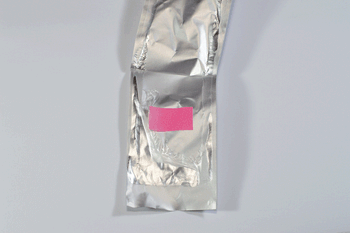
The aim of this study was to develop and optimize an orally dissolving film formulation containing a blend of active ingredients in a strategic combination of natural and synthetic excipients to achieve a balance between controlled actives release and rapid onset of action.
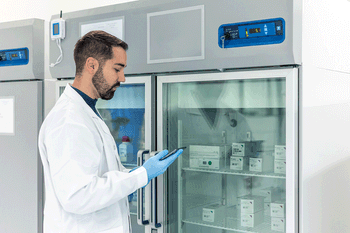
The scientific basis, regulatory expectations, validation approaches of hold times in biopharmaceuticals are presented along with real-world examples.

PharmTech Europe's June 2026 issue reflects the convergence of compliance burden, cost pressure, analytical complexity, and patient access.
Kristin Ciriello Pothier, KPMG US, discusses why pharma dealmaking slowed in early 2026, but how AI partnerships, manufacturing acquisitions, and oncology are driving a second-half rebound.
AI governance, nitrosamine risks, and surging US manufacturing investment reshape quality systems, deals, and workforce needs.

US opens Section 301 probe into Germany's drug pricing, threatening tariffs that could disrupt API supply chains and reshape pharma manufacturing investment.

First generic of single-dose flu drug baloxavir marboxil approved by FDA ahead of 2026–2027 season, expanding antiviral access and manufacturing competition.

A comprehensive approach to long-term sustainability efforts in pharmaceutical manufacturing should prioritize simpler frameworks that curb costs, risks, and variability.
Kristin Ciriello Pothier, KPMG US, explains why supply chain resilience and platform technology diligence are reshaping biopharma M&A valuations globally.

Reducing Environmental Impact in Pharmaceutical Packaging Without Compromising Performance
ByDatwyler
Webcasts
Webinar Date/Time: Thu, Jul 16, 2026 11:00 AM EDT
Advertisement
Advertisement
Trending on Pharmaceutical Technology
1
Formulation Strategies for Next-Generation Multiagonists
2
NVIDIA’s $250M Agentic AI Safety Bet: What GMP Gains
3
Manufacturing Intelligence: What FDA's Real-World Use Case Database Means for CMC
4
MASH and Cardiomyopathy Targets: Why AstraZeneca Chose insitro’s AI
5