



The Office of the United States Trade Representative issued a report as part of its annual review of the global state of intellectual-property rights protection and enforcement.

The Office of the United States Trade Representative issued a report as part of its annual review of the global state of intellectual-property rights protection and enforcement.

In fiscal year 2010, the number of patent settlements in which the manufacturers of branded products paid makers of generic drugs to postpone the introduction of their products reached its highest level ever, according to the Federal Trade Commission.

The IPEC is soliciting public comment about a draft plan for the independent certification of manufacturers and suppliers of pharmaceutical excipients.

An upcoming conference by the Drug, Chemical and Associated Technologies Association (DCAT) will focus on innovative practices and strategies for optimizing sourcing, procurement, and the management of the pharmaceutical supply chain.

Extending a drug product's shelf life while maintaining its strength, quality and purity is a challenge for pharma companies.

There are a number of points to consider where secondary packaging is concerned.

Legislation has prompted the pharma industry to seek technologies that can be used to secure a product throughout the supply chain.

More challenges face the pharma packaging industry today than ever before, according to Domino Printing Sciences' global life sciences sector manager.

In light of the challenges facing the pharma industry, such as changing patient demands and changing demographics, the relationship between the packaging, the consumer and the product is being completely reconsidered.

Research conducted in the UK by the University of Leeds and Luto Research shows that many commonly-used phrases on medicine labels are easily misunderstood.

Eastern Europe's pharmaceutical leader, Hungary, is working to maintain its number-one status while also pursuing new avenues, especially in biopharmaceuticals.

Visitors found new container options, child-resistant concepts, and serialization solutions. This article contains bonus online material.

Lessons from the earthquake in Japan show the vulnerability of the bio/pharma supply chain.

Editor's picks of analytical instrumentation products for May 2011.

Regulators and standard-setting bodies are re-examining over-the-counter drugs.

The author argues that traditional concerns about repeatability and intermediate precision remain valid but insufficient.

The authors develop a pratical approach to avoid unwanted interactions between pepsin and SLS in dissolution Tier II tests.

The authors examine the influence of glass-transition temperature, melt viscosity, degradation temperature, and process settings.

Emerging methods could provide alternative ways of producing inhalable drug particles.

Approaches in using small-molecule and peptide synthesis offer promise in widening the scope of drug candidates.

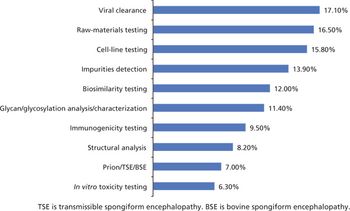
Those who doubt there's faith in science, should check out our annual Bioprocessing Survey.

FDA, NIH and industry seek new strategies to spur drug development and promote access to therapies.

Can the semiconductor industry help Big Pharma develop therapies?

Innovator and generic-drug companies need to adapt to compete in the biosimilars market.

Many factors affect research results.