

The management board of the European Medicines Agency has introduced a range of new measures to strengthen and extend its conflicts of interest policy for scientific-committee members and experts, as well as for members of the management board.
The management board of the European Medicines Agency has introduced a range of new measures to strengthen and extend its conflicts of interest policy for scientific-committee members and experts, as well as for members of the management board.
PTSM: Pharmaceutical Technology Sourcing and Management
The decision by the Indian patent authorities to issue a compulsory license for a generic version of a Bayer anticancer drug engenders debate.

Failure to disclose info may work sometimes, but eventually every question will be answered.

Soaring opioid use creates challenges for new drug development and supply-chain control.

Comparison of the top GMP deficiencies cited by the PIC/S Participating Authorities.

China's drug-distribution network has been a mess for years, but government reforms and industry focus are unveiling new opportunities for market order and growth.

The contract provider needs to know as much as the NDA holder.
On Mar. 13, 2012, FDA issued a Warning Letter to Steven Victor, CEO of IntelliCell Biosciences for a violation of the Food, Drug, and Cosmetic Act, and for violations of cGMP and Good Tissue Practice in the manufacture of its adipose tissue-derived stem-cell product.
On Mar. 12, 2012, FDA released a draft guidance document for industry direct-to-consumer television advertisements that describes FDA's plans for implementing predissemination review.
FDA has issued a list of planned draft and final guidance documents for release throughout 2012. There are approximately 50 such guidances planned.
In a world where product recalls can mean the end of a company, all batches must be perfect.

Brazil's generic-drug market is growing steadily.

Social media use raises questions about applying old standards to new information technology.

FDA's treatment of whistleblowers lacks internal consistency.
The author reviews significant changes to GMP for excipients in the forthcoming American National Standard, including a risk-based approach to excipient manufacture, why new requirements were proposed, and their potential impact to excipient manufacturers.

This article provides guidance for industry on how to comply with the pending American National Standard on excipient GMP, with a focus on risk assessment.
FDA answers key questions about the October 2011 guidance on using physical–chemical identifiers in solid oral dosage products to help prevent and avoid counterfeiting.
GlaxoSmithKline is recalling 394,230 bottles containing its antihypertensive drug DynaCirc CR (isradipine) controlled-release tablets. The lots are being recalled due to concerns regarding the level of cGMP compliance and procedural controls related to line clearance during the packing process at the Lincoln, Nebraska, facility of Novartis Consumer Health, where the product is made.
On Feb. 17, 2012, McNeil Consumer Healthcare, a division of McNeil-PPC, a subsidiary of Johnson & Johnson, voluntarily recalled approximately 574,000 bottles of its OTC pain reliever and fever reducer Infants' Tylenol Oral Suspension, 1 oz. Grape. The voluntary recall was initiated after consumers complained of having difficulty using the SimpleMeasure dosing system.
On Feb. 21, 2011, FDA posted a copy of a Warning Letter that was sent to the chairman of the executive board of Merck KGaA on Dec. 15, 2011, regarding cGMP violations identified at three of its European facilities: MS-Corsier-sur-Vevey, MS-Aubonne, and MS-Tiburtina.
FDA has released a draft guidance for API manufacturers in response to a 2008 incident in which heparin sourced from China was adulterated with oversulfated chondroitin sulfate, causing serious adverse reactions in patients.
The EMA has published a guideline that addresses the influence of patients? genetic variability on drug pharmacokinetics.
After months of anticipation, the Food and Drug Administration issued guidances last month that outlines its recommendations for developing and approving biosimilar therapies.
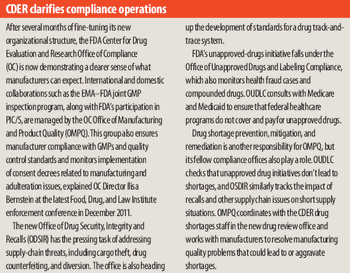
More collaboration and expanded oversight aim to compel manufacturers to follow GMPs.
A nickel's worth of free advice to the competition could come at the expense of your bottom line.