Pauric Bannigan, Intrepid Labs, explains where AI speeds formulation decisions, why data is the bottleneck, and how active learning trains models with far less data.
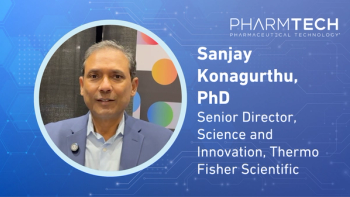
Sanjay Konagurthu, PhD, senior director of Science and Innovation at Thermo Fisher Scientific, explains what teams need to do to ensure the usefulness of AI and what strides have been made with AI in regulatory submissions.
Sanjay Konagurthu, PhD, senior director of Science and Innovation at Thermo Fisher Scientific, spoke with PharmTech at AAPS PharmSci 360 2026 about what goes into building a successful artificial intelligence (AI) strategy for oral drug product development. He also provided insight into how regulators expect AI evidence to be handled, and why data remains the biggest obstacle to the adoption of AI.
Success depends on well-structured access to data and close collaboration across three groups, according to Konagurthu. Formulation scientists design the dosage form, weighing excipient choice, API properties, and unit operations. Analytical scientists characterize the formulation’s physical and chemical attributes. Data scientists turn that data into models that can be validated, he explained.
On regulation, he noted that AI evidence supporting drug product quality or other regulatory decisions should be fit for purpose and backed by an appropriate level of validation. He pointed to the FDA’s recent nonbinding draft guidance and to shared FDA and European Medicines Agency principles emphasizing clear intended use, sound data management and governance, performance assessment, human oversight, and lifecycle management. Sponsors using these tools, he said, should keep an auditable record of data, model versions, validation results, limitations, human review, and any postvalidation changes.
Konagurthu said he expects near-term progress in optimizing the manufacturability and dissolution of tablets and capsules, and in formulation screening for poorly soluble small molecules through platforms such as Thermo Fisher’s Quadrant 2. These platforms produce measurable outcomes that can guide the next experiment. Predicting clinical exposure from an API’s structure and properties remains the “holy grail,” and his team is working on it. To prepare, he advised companies to standardize formulation and dissolution data and connect lab records to process and material attributes.
Data access is still the biggest hurdle, he stressed. In his view, well-organized data are 80% to 90% of the task, with model building and validation coming later. Although models are advancing rapidly, he said that he expects the industry to make real progress on data access within 2 to 5 years.
Konagurthu gave the keynote presentation, 3D Printing: Driving Digital Transformation from Dosage Form Design to Product Development and Manufacturing, at