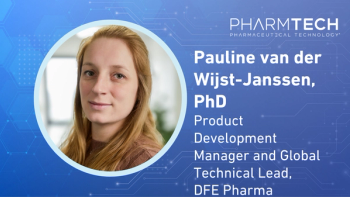
Pauline van der Wijst-Janssen, PhD, of DFE Pharma, won the CPHI Pharma Award for Future Leader. In this interview with PharmTech, she provides advice for scientists looking to advance to leadership roles.
CPHI Award winner, Pauline van der Wijst-Janssen, PhD, product development manager and global technical lead at DFE Pharma, explains excipient variability and excipients’ role in continuous manufacturing.
At CPHI Milan 2026, Pauline van der Wijst-Janssen, PhD, product development manager and global technical lead at DFE Pharma, won the CPHI Award for Future Leader. With expertise in excipients, Wijst-Janssen told PharmTech that formulation risk often starts early in the development process, when excipients are chosen for familiarity, availability, or success in a laboratory batch. One good batch shows feasibility but says little about robustness when materials, equipment, or conditions change. During scale-up, small differences in particle size or density can become significant, she explains. At commercial scale, where processes run at high throughput, variability can reduce output, interrupt processes, and cause out-of-specification batches. These costs far exceed the price of the excipient itself. She called variability inevitable but not a sign that a process is out of control. Batches that both comply with the pharmacopeia can still perform very differently. Therefore, developers should identify the excipient characteristics that matter for their application, set acceptable ranges, and ask suppliers about typical variability while there is still room to build robustness into the formulation.
When it comes to the types of excipients used in continuous manufacturing, Wijst-Janssen said continuous manufacturing does not automatically require different excipients. What changes is how materials enter the process and how disturbances move through connected operations. Feeding depends on the powder, the feeder, and the operating rate, so success in a batch plant does not guarantee consistent feeding. A common mistake, she warns, is to treat the transition as an equipment swap and leave material assumptions unchanged. Pointing to the International Council for Harmonisation’s Q13’s focus on raw material variability, she noted that DFE Pharma has introduced continuous manufacturing variants of its excipients. These have specifications that reflect actual variability.
On nitrites, she said the marketing authorization holder owns the product-specific risk assessment, but the work must be collaborative. Suppliers cannot assess finished products, but they can reduce and control nitrite levels and share reliable analytical and stability data. That evidence can support market entry or reduce routine finished-product testing, depending on the region.
Dr. Pauline Janssen is Product Development Manager and Global Technical Lead at DFE Pharma. With a background in physical chemistry and powder technologies, she leads a team of product developers creating science-based solutions for pharmaceutical applications. Pauline has set product development priorities and supported her team’s growth, with a focus on continuous improvement and project delivery.
As Global Technical Lead, Pauline connects fundamental science with customer needs. She develops excipient application knowledge and shares insights through peer-reviewed publications and technical materials. Working with customers and partners worldwide, she uses their input to guide innovation and address formulation challenges.
Her recognition as winner of the Future Leader category of the CPHI Pharma Awards 2026 highlights her scientific contributions and leadership in pharmaceutical excipient innovation.