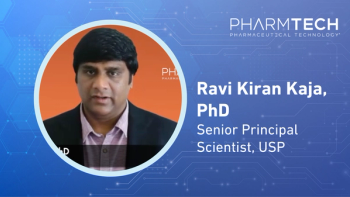
Ravi Kiran Kaja, PhD, USP, explains what harmonization of extractables and leachables standards looks like in practice.
In a preview of their panel discussion at AAPS PharmSci 360 2026, Alfred Rumondor, PhD, AbbVie, and Swita Singh, PhD, Bristol Myers Squibb, discuss navigating CMC requirements for new modalities and AI’s involvement in CMC.
PharmTech spoke with Alfred Rumondor, PhD, director, Development Sciences Licensing and Acquisitions,at AbbVie, and Swita Singh, PhD, senior director and strategic CMC leader at Bristol Myers Squibb, to learn more about their upcoming panel discussion, Navigating CMC Strategy in the Current Landscape, at
Singh addresses the challenge facing cell and gene therapy products, in vivo gene editing, and cell-based combination products, which is that modalities often lack established regulatory guidance. Singh suggests that when precedent doesn't apply, teams should return to the core statutory and quality standards of identity, strength, quality, purity, and potency, then build a control strategy around the modality’s specific risk factors.
She also recommends deliberately leveraging adjacent precedent, even without direct guidance for a given modality, relevant precedent from related modalities may still apply. She urged sponsors to engage the FDA early and often through formal pathways like INTERACT meetings and Type B pre-investigational new drug approval meetings, rather than waiting for guidance documents to be issued; these programs exist specifically for precedent-free scenarios, and proactive engagement helps bring the agency along the development journey.
Finally, Singh advised planning for iteration from the outset: new, precedent-free modalities inevitably require more comparability work as manufacturing is refined, so companies should establish a comparability protocol and a banked reference material strategy from day one rather than reacting later.
Rumondor provided his insight on how AI is reshaping CMC work by simplifying tasks once considered labor- and resource-intensive, using computational approaches to accelerate work that previously took significant time and effort. He emphasizes that AI doesn’t eliminate the need for experimentation but enhances it. As an example, he points to solid-form selection during development, where AI—paired with computational modeling—can help investigate potential stable forms, dramatically cutting the number of required experiments and enabling faster, more comprehensive form selection. He notes this is just one of many role-specific applications, all pointing toward smarter, faster work with fewer resources.
Click the video above to watch the interview.