News|Articles|July 8, 2022

Bio-Rad Launches CFX Opus Deepwell Real-Time PCR Detection System

Bio-Rad’s CFX Opus Deepwell Real-Time PCR Detection System is designed to support researchers in developing nucleic acid detection assays.

Bio-Rad Laboratories’s new CFX Opus Deepwell Real-Time Polymerase Chain Reaction (PCR) Detection System is designed to support researchers in developing nucleic acid detection assays. The product, launched in June 2022, is the latest in Bio-Rad’s portfolio of CFX Opus Real-Time PCR instruments.

The CFX Opus Deepwell has a 96-well block and a reaction volume of up to 125 µl, the largest in the CFX Opus range, according to Bio-Rad in a June 27, 2022 press release. The system can multiplex up to five targets simultaneously and supports fluorescence resonance energy transfer applications.

According to the release, the deeper sample wells are designed for workflows requiring larger reaction volumes for pooling, certain sample prep procedures, and other specialized protocols, such as food and industrial testing or veterinary pathogen detection. The CFX Opus Deepwell can be linked to Bio-Rad’s BR.io platform, which provides remote setup, instrument monitoring, and cloud data management solutions.

"We are witnessing an increasing demand for improved real-time PCR systems that offer more efficient workflows and enhanced data management and analysis," said Steven Blakely, director, Gene Expression and Software Technology, Bio-Rad, in the press release. "We're pleased to expand our portfolio of CFX Opus Detection Systems with the Deepwell format to help researchers perform experiments more efficiently and to consistently deliver robust datasets."

Source: Bio-Rad


Related to this article

Glass vial, pipette and woman scientist in laboratory for medical study, research or experiment. Test tube, dropper and professional female person with chemical liquid for pharmaceutical innovation. | Image Credit: ©HockleyMedia24/peopleimages.com -stock.adobe.com
Equivalence test using two one-sided tests are widely used for demonstrating the comparability of treatment effects in different research fields. The method described in the manuscript aims to use simulations in Microsoft Excel to compute power for 2 one-sided tests for two groups with unequal variances.
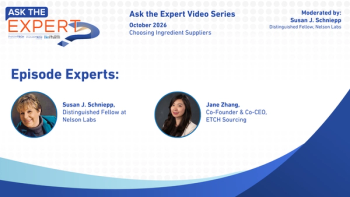
Ask the Expert: Choosing Ingredient Suppliers
Jane Zhang of ETCH Sourcing explains why geopolitics, transparency, and partnership now weigh as heavily as cost and quality when companies choose suppliers, in this episode of Ask the Expert, moderated by Susan J. Schniepp of Nelson Labs.