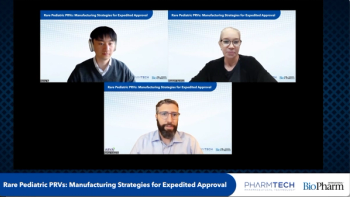
Nate Edwards of Arya Consulting moderates a discussion with Elisabeth Gardiner of Tevard Biosciences and Donny Xu of the RTW Institute about the regulatory and manufacturing hurdles facing rare disease drug developers.
The companies’ “Change the Target. Change What’s Possible” targets the potential of Factor XIa inhibition in the development of treatments for thromboembolic disease.
Bristol Myers Squibb (BMS) and Johnson & Johnson (J&J) announced they have launched a new educational initiative, “Change the Target. Change What’s Possible,” aimed at redefining the approach to cardiovascular and thromboembolic care.1 This program focuses on the emerging potential of Factor XIa (FXIa) inhibition, a target to address persistent challenges in drug development, such as preventing dangerous blood clots without compromising the body’s natural ability to heal.
"Despite advances in cardiovascular care, some patients with thromboembolic disease remain at high risk because current therapies may require difficult trade-offs between efficacy and bleeding,” said Tania Small, MD, senior vice president and head of Medical Affairs, BMS, in the press release.1 “A better understanding of the coagulation cascade has led to the identification of new targets, such as factor XIa, informing how we approach the research of thrombosis prevention while preserving healthy clotting.”
Despite a robust market of existing anticoagulants, cardiovascular and thromboembolic diseases remain a primary driver of global mortality, accounting for nearly 1 million deaths in the United States annually, according to BMS.1 The current landscape is defined by the following gaps in protection:
“With heart disease and stroke among the leading causes of death and disability worldwide, it is imperative to continue research in preventing these events,” said Clay Johnston, MD, PhD, MPH, co-founder, chief medical officer, Harbor Health in Austin, Texas, in a BMS press release.1 “Patients at risk for stroke and other thromboembolic events really need drugs that reduce the risk of dangerous clots without increasing their bleeding risk, and targeting factor XIa may open this possibility.”
BMS and J&J have been working together to find treatments for vascular and thromboembolic diseases, with a patient-centric approach that relies on real-life experiences.2
Factor XIa has a unique role in thrombin generation and clot propagation. While traditional anticoagulants often inhibit factors within the “common pathway”—which can inadvertently impair healthy clotting—targeting FXIa offers a more surgical approach.
The primary goal of this research is todecouple hemostasis (healthy clotting) from thrombosis (the formation of harmful clots), according to BMS.By inhibiting FXIa, researchers believe it may be possible to prevent the formation of dangerous clots while preserving the body’s ability to form “good clots” that reduce bleeding complications.
The alliance between BMS and J&J reflects a growing trend of high-level collaboration in the pharmaceutical sector to address complex disease states. By combining their respective scientific expertise and commercial infrastructures, the two companies aim to overcome the limitations of current treatments and close the gap in thrombosis management.
The collaboration will extend to the support of broader cardiovascular and neurological communities through partnerships with patient advocacy organizations; this may signal a long-term commitment to investigating FXIa as a potential treatment for a wide range of thromboembolic diseases.
As the “Change the Target” campaign rolls out, the focus will remain on clinician education regarding the coagulation cascade and the potential of FXIa to meet currently unmet needs. The success of this initiative could redefine the standard of care for patients at high risk of stroke and other thromboembolic events, finally moving past the era of “trade-off” medicine.