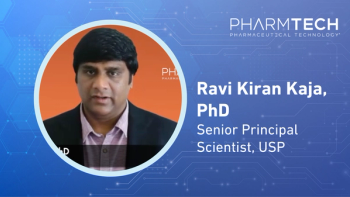
Ravi Kiran Kaja, PhD, USP, explains what harmonization of extractables and leachables standards looks like in practice.
Andrew Parker, PhD, executive drug development consultant, Quotient Sciences, explains that developing a molecule requires a holistic view of its chemical, physical, and biological properties.
As part of PharmTech’s coverage of
Understanding where a compound sits on the solubility-permeability plot helps determine which enabling technology is likely to succeed, whether that's amorphous solid dispersions, lipid-based systems, or simple particle size reduction for dissolution-limited compounds, according to Parker.
Parker stresses that manufacturability and scale-up risks must be considered from the earliest stages, not addressed retroactively. He uses amorphous solid dispersions as an example: the same drug-polymer combination can behave differently depending on whether it’s produced by spray drying or hot melt extrusion, each yielding distinct solid-state stability pathways that affect long-term performance. For spray-dried products specifically, parameters such as spray rate, temperature, and residual solvent levels must be tightly controlled during tech transfer and scale-up to keep particle morphology and material properties consistent across equipment sizes and manufacturing sites. Failing to plan for this early can force costly re-engineering later, potentially undermining data already used to support clinical development.
Artificial intelligence (AI) is playing a greater role in drug development. AI has shortened formulation development timelines, particularly on the drug product side. AI has enhanced formulators ability to use Bayesian optimization, rather than relying on traditional design-of-experiments approaches, to more quickly converge on a target formulation profile, streamlining the path to optimized, finalized compositions for both drug substance and drug product development.
Quotient Sciences can be found at Booth 6K73 at CPHI Milan, which is occurring from October 6-8, 2026.
Click the video above to watch part 1 of this 2-part interview.