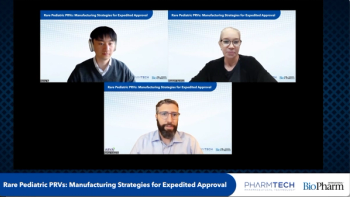
Nate Edwards of Arya Consulting moderates a discussion with Elisabeth Gardiner of Tevard Biosciences and Donny Xu of the RTW Institute about the regulatory and manufacturing hurdles facing rare disease drug developers.
Pharmaceutical Technology Europe
Proteasome-targeting therapies may eliminate disease-causing proteins in a broad range of diseases.
Momentum is building for proteolysis-targeting chimeras (PROTAC) treatments that hijack the ubiquitin-proteasome system (UPS) to catalytically degrade pathogenic proteins and eliminate disease-causing proteins.1.2 This approach enables scientists to target previously "undruggable" proteins and exert sustained pharmacological effects, including those responsible for difficult-to-treat childhood cancers and drug-resistant triple-negative breast cancer.1.3 In recent years, significant progress has been made in the selective delivery of PROTACs, potentially extending their use to a broader range of conditions.4
A number of proteasome-targeting therapies have been approved in Europe and the United States, such as Amgen’s carfilzomib (Kyprolis), Bristol Myers Squibb’s ixazomib (Ninlaro), and Johnson & Johnson/Takeda’s bortezomib (Velcade). Several Big Pharma companies—AbbVie, AstraZeneca, Eli Lilly, Merck & Co, Novartis, Pfizer, Roche, and Sanofi—have products in clinical development. Interest in this field has catalyzed some interesting acquisitions and partnerships. For instance, in 2025, Johnson & Johnson completed its acquisition of Halda Therapeutics to gain access to its novel Regulated Induced Proximity Targeting Chimaeras (RIPTACs), a protein degradation approach that connects with proteasome pathways.5 In September 2025, Novartis initiated a collaboration with US-based Monte Rose to develop novel degraders or molecular glues to treat immune-mediated diseases.6
Several biotech companies in the US are developing second-generation PROTACs, including Arvinas' vepdegestrant (ARV-471). In March 2025, Pfizer and Arvinas announced positive topline results from the phase 3 VERITAC-2 clinical trial with vepdegestrant in metastatic breast cancer.7 Additionally, C4 Therapeutics and Nurix Therapeutics have protein degrader programs: cemisoldomide in phase 1/2 for multiple myeloma/non-Hodgkin lymphoma (NHL), and bexobrutideg in phase 2/3 for relapsed/refractory chronic lymphocytic leukaemia (R/R CLL), respectively.8.9.10
More recently, US-based Kymera Therapeutics received fast track designation from the US FDA for KT-621, an oral signal transducer and activator of transcription 6 (STAT6) degrader for the treatment of atopic dermatitis.11 In 2025, Sanofi modified its collaboration with Kymera, discontinuing development of KT-474, an Interleukin-1 receptor-associated kinase 4 (IRAK4) degrader, while continuing development of KT-485, which is in phase 2 trials for atopic dermatitis and hidradenitis suppurativa.12 Other US biotech companies working in this field include Accutar Biotech, Cleave Therapeutics, Dialectic Therapeutics, and Karyopharm Therapeutics.
Several European biotechs are evaluating a new class of inhibitors that harness the UPS, hijacking the proteasome to provide disease-specific protein degradation with a wide range of therapeutic applications from autoimmune to oncology.
Amphista Therapeutics (United Kingdom) has developed its proprietary next-generation targeted protein degradation (TPD) technology to develop Targeted Glues. Its lead program, AMX-883, can induce BRD9 degradation to block patient-derived tumour growth in vivo as a monotherapy, with superiority to venetoclax in acute myeloid leukaemia (AML).13
Booster Therapeutics (Germany) focuses on developing small-molecule proteasome activators for neurodegenerative disease using its DGRADX platform. In October 2025, the company completed a US$15 million financing round led by life sciences investors Apollo Health Ventures and Novo Holding.14 Funds will be used to advance its multidisease pipeline.
OncoOne (Austria) focuses on the development of precision medicine using site-restricted targeted therapeutics. OncoOne’s research encompasses the development of targeted immunotherapeutics that modulate tumour degradation using its Pre-Targ-it platform. The company is exploring therapies that target the proteasome-Bcl-2 axis as novel anticancer agents.15
QLi5 Therapeutics GmbH (German-Korean joint venture) is working on a new class of proteasome inhibitors that demonstrate strong anti-tumour and anti-inflammatory activity, offering promise in cancer, autoimmune, and inflammatory disorders.16 In September 2025, Qli5 closed a €10 million (US$12 million) Series A financing round with an international consortium of investors, including SV Investment (Korea), KHAN Technology Transfer Fund I (Germany), Atinum Investment (Korea), and DAOL Investment (formerly KTB, Korea). The proceeds will advance its pipeline of proteasome inhibitors in clinical development.17
According to market research, the global proteasome inhibitor market was valued at approximately US$2.7 billion in 2024 and is projected to reach US$3.03 billion in 2024, growing to approximately US$6.1 billion by 2034, with a compound annual growth rate of 8.70% from 2025 to 2034.18 Preliminary research indicated that proteasomes may have far-reaching effects and could be used to target new immune defence mechanisms.19 Currently, companies are focusing on developing proteasome inhibitors for oncology; however, these agents may also present new opportunities to treat patients with inflammatory and autoimmune diseases. Many large pharmaceutical companies have already forged strategic partnerships with research institutions and biotech companies to advance PROATCs and UPS, either as standalone therapies or in combination with existing therapies. Several late-stage clinical trials will read out over the next 12 to 24 months, and promising results could stimulate further investment in this area.
Cheryl Barton, PhD, is founder and director of PharmaVision, Pharmavision.co.uk.