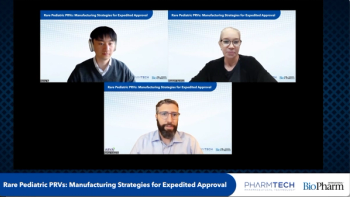
Nate Edwards of Arya Consulting moderates a discussion with Elisabeth Gardiner of Tevard Biosciences and Donny Xu of the RTW Institute about the regulatory and manufacturing hurdles facing rare disease drug developers.
Larry Kranking, president and CEO of Coldstream Laboratories, discusses industry trends and challenges.
PharmTech:
How do you stay abreast of new developments in the industry?
Larry Kranking
Kranking:
We work hard to network with colleagues in the biopharmaceutical arena by participating in societies such as the Parenteral Drug Association, the International Society for Pharmaceutical Engineering, and the American Association of Pharmaceutical Scientists. We also find that another great source for information concerning new developments in the sterile drug product area is our customers. Our clients are constantly challenging us with new products and manufacturing needs. We use client quality audits to ensure that Coldstream Laboratories stays in tune with the latest regulatory guidelines and trends. Client auditors and their consultants are a rich source of current thought pertaining to what the US Food and Drug Administration expects of sterile drug-product manufacturers, and we try to learn from every interaction we have with them.
PharmTech:
Do you see a new industry trend emerging?
Kranking:
We have seen a trend toward complex formulations, including a higher percentage of lyophilized products as well as suspensions, nanoparticulates, and other formulations that are more complex than standard aqueous solutions. Fortunately, Coldstream's isolator-based manufacturing suite allows us to employ a wide variety of technologies in a safe manner that also simplifies sterility assurance.
PharmTech:
What is the most common demand your clients are currently making of you?
Kranking:
Many of Coldstream's clients are interested in manufacturing nontraditional parenteral products that involve unique handling challenges and complex steps. Such products require a high degree of flexibility on the part of the drug-product manufacturer.
In addition, clients typically are interested in moving quickly once they have decided to manufacture a drug product. Again, this demands maximum flexibility and quick reaction on the part of our development and manufacturing teams.
almost 16 years ago
Pharmaceutical Technology, December 2010 Issue (PDF)almost 16 years ago
Quality Issues Reduxalmost 16 years ago
Riding the Employment Roller Coasteralmost 16 years ago
Pharma Faces New Political Landscapealmost 16 years ago
Report from Asiaalmost 16 years ago
A Catalyst for Green Synthesisalmost 16 years ago
In the Spotlight December 2010almost 16 years ago
Intellectual Property as the Foundation of Innovationalmost 16 years ago
Packagers for Hirealmost 16 years ago
Global Healthcare on the Ground: Differential Pricing