News|Articles|July 2, 2018
- Pharmaceutical Technology\'s In the Lab eNewsletter-07-03-2018
- Volume 13
- Issue 7
Sciex’s New Mass Spec Technologies Enhance Lab Analytics
Author(s)Pharmaceutical Technology Editors
Sciex’s latest additions to its biopharma portfolio helps to optimize workflow for better analytics in the lab.
Sciex’s latest additions to its biopharma portfolio help to optimize workflow for better analytics in the lab.
According to the company, these products have been optimized for maximal sensitivity, accuracy, and efficiency for scientists using challenging workflows in critical fields without sacrificing robustness or ease of use.
Recent additions to the Sciex biopharma portfolio include:
- OptiFlow Quant Solution, which delivers highly sensitive micro-flow quantitation for peptides. This solution includes the OptiFlow Turbo V Source with M5 MicroLC to deliver micro-flow sensitivity at analytical flow usability, with flexible and user-friendly sample handling.
- Multiple Attribute Methodology (MAM) Workflow for simplified, in-depth liquid chromatography-mass spectrometry characterization and development of biologics. The MAM Workflow provides complete analysis of the product quality profile while minimizing the burden of product-quality attribute monitoring and product purity testing and uses the company’s BioPharmaView 3.0 software.
- the SCIEX OS 1.4 software brings the full package for quantitative and qualitative analysis to the majority of SCIEX instruments. The new operating system also offers complete 21 CFR Part 11 compliance for labs in regulated fields.
- the MPX 2.0 software, which was recently developed for multiplexing liquid chromatography separations within a single mass spectrometry system, saves valuable laboratory time while improving flexibility, according to the company.
The company showcased these innovations at ASMS 2018 on June 3–7, 2018 in San Diego, CA.
Source:
Articles in this issue
over 8 years ago
Dissolution Testing: Keeping It Simpleover 8 years ago
Improvements Needed for Adventitious Agent Testingover 8 years ago
Alcami Expands Laboratory Services Programover 8 years ago
Shimadzu’s New Q-TOF System Enhances Mass Spectrometryover 8 years ago
Waters’ New UPLC Platform Meets Evolving Chromatography Needsover 8 years ago
Juniper Pharma Services Expands Laboratory Facilitiesover 8 years ago
Micromeritics Acquires Freeman TechnologyRelated to this article
Impurity deficiencies in submissions are remarkably consistent. Subathra Ramamoorthy, Veranova, explains how to catch them before agency filing.

Subathra Ramamoorthy, Veranova, on how forced degradation and trace impurity profiling in potent APIs shape regulator-ready analytical methods.

Subathra Ramamoorthy, Veranova, on when to escalate to structural elucidation and pair orthogonal techniques when characterizing an impurity.

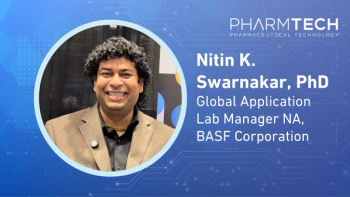
Nitin Kumar Swarnakar, PhD, global application lab manager at BASF, talks about spray drying for drying amorphous solid dispersions and Raman spectroscopy’s role as a quantitative analytical tool.

From AI validation to microstructure imaging, AAPS PharmSci 360 speakers pushed toward faster drug development backed by stronger evidence. Here are PharmTech's biggest takeaways.

The FDA approves asundexian, the first factor XIa inhibitor, cutting stroke risk 26% and setting a regulatory benchmark for factor XI drug developers.

Panelists on the PharmTech AI Pulse Check weigh a December AI playbook, EMA/MHRA moves, PCCP accountability gaps, and MCP-ready regulatory guidance.
Trending on Pharmaceutical Technology
1
Why Drug Shortages Average 5+ Years: PharmTech Explained
2
CDMOs, OEMs, and Used Equipment Resellers are Joining Forces to Onshore Pharmaceutical Manufacturing
3
What the First Factor XIa Approval Means for Developers
4
France Remains One of Europe’s Leading Biotech Funding Hubs
5