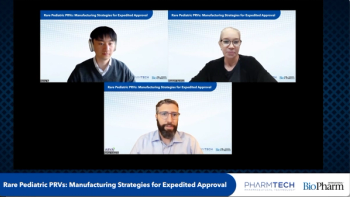
Nate Edwards of Arya Consulting moderates a discussion with Elisabeth Gardiner of Tevard Biosciences and Donny Xu of the RTW Institute about the regulatory and manufacturing hurdles facing rare disease drug developers.
Pathos AI's $2.09 billion license for Alphamab's TNBC drug JSKN016 signals rising cross-border oncology deals and manufacturing coordination demands.
Pathos AI agreed to pay $125 million upfront to a subsidiary of Alphamab Oncology for rights to an experimental treatment for triple-negative breast cancer, the company announced on July 3, 2026.1 The agreement gives Pathos AI research, development, manufacturing, and commercialization rights to the antibody-drug conjugate (ADC) candidate, known as JSKN016, everywhere except Taiwan, Macau, Hong Kong, and mainland China.
Beyond the initial payment, Jiangsu Alphamab Biopharmaceutical is eligible for additional development and commercialization milestone payments.1 Combined with the upfront sum, the total deal value could reach as much as $2.09 billion if all milestones are met.
Triple-negative breast cancer is an aggressive subtype that tends to grow and spread more quickly than other forms of the disease, and it comes with fewer treatment options for patients.1 It accounts for roughly 10% to 15% of all breast cancer diagnoses. Current treatment options include Merck's Keytruda and Gilead's Trodelvy, both of which have shown measurable benefit in reducing recurrence risk in recent trials. JSKN016 is currently in a late-stage trial for triple-negative breast cancer, along with earlier-stage studies evaluating its use in other tumor types.
Iker Huerga, chief executive, Pathos AI, said in a press release,2 "JSKN016 is a next-generation bispecific ADC with the potential to address significant unmet need across a range of solid tumors, and we are excited to advance it in partnership with Alphamab. This program was identified through Foundry, the same platform that continues to guide portfolio decisions across our clinical pipeline. This collaboration reflects our shared commitment to bringing differentiated therapies to patients."
JSKN016 is a bispecific ADC that targets both TROP2 and HER3 receptors on tumor cells, using site-specific glycosylation to produce a homogeneous conjugate with a drug-to-antibody ratio of four.2 The molecule blocks associated signaling pathways and releases topoisomerase I inhibitors through cellular endocytosis. Pathos AI identified the asset through Foundry, its internal platform that applies large-scale data analysis to portfolio decisions, making JSKN016 the fourth clinical-stage program added through that process. It joins 3 other pipeline candidates targeting prostate cancer, multiple myeloma, lung cancer, and breast cancer, reflecting a broader push toward AI-assisted asset selection in oncology development.
Licensing agreements of this structure and scale are becoming a defining feature of oncology drug development, and this transaction offers a useful window into how that dynamic is playing out.1 Rather than building an oncology pipeline entirely through internal discovery, companies are increasingly securing rights to clinical-stage assets originating from biopharmaceutical developers in China, where a growing share of novel oncology candidates are now entering trials. This pattern carries direct implications for development and manufacturing: cross-border licensing deals often require technology transfer, harmonization of manufacturing processes across regulatory jurisdictions, and coordination between original developers and new rights holders on quality systems and supply chain planning.
The milestone-heavy structure of the agreement also reflects how risk is increasingly distributed across the development timeline in oncology licensing deals, with a comparatively modest upfront payment tied to a much larger sum contingent on clinical and regulatory progress.1 That structure places pressure on development and manufacturing functions to execute efficiently at each stage, because delays or setbacks can directly affect deal economics for both parties.
For professionals tracking the competitive landscape in triple-negative breast cancer treatment, the entry of another asset into late-stage development adds to a field that already includes established options.1 As more candidates advance through clinical trials, manufacturing scale-up, quality compliance, and supply chain readiness will become increasingly important differentiators, particularly for smaller or newer entrants competing against companies with established commercial infrastructure.
References