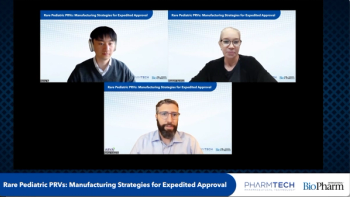
Nate Edwards of Arya Consulting moderates a discussion with Elisabeth Gardiner of Tevard Biosciences and Donny Xu of the RTW Institute about the regulatory and manufacturing hurdles facing rare disease drug developers.
PharmTech spoke with Klaudia Lechowska, Business Development Specialist at Mabion Biologics CDMO, about how women working in STEM fields bring unique perspectives to the important work of rare disease treatment.
The
Lechowska (Mabion Biologics): My name is Klaudia and I have been working at Mabion for four years. I started my career as a bioprocess technician in the manufacturing department, where I was responsible for cell culture operations at both small scale, such as shake flasks, and large production scale in bioreactors. This experience gave me a strong technical background and a solid understanding of bioprocessing operations. Currently, I work as a business development specialist, where I develop my negotiation skills and establish contacts with potential clients interested in our contract development and manufacturing (CDMO) services.
I believe STEM programs play an important role in encouraging girls to explore science and technology from an early age. These programs help build confidence and show that technical fields can be interesting and accessible for everyone.
From my own experience, early exposure to technical education makes it easier to understand how scientific knowledge is used in real-life industries such as pharmaceuticals and biotechnology. STEM programs help girls develop problem-solving, teamwork, and critical thinking skills, which are essential in this industry.
My career path, from working in manufacturing to my current role in business development, shows how valuable it is to combine technical knowledge with communication and business skills. This is exactly what STEM education supports and why it creates a strong foundation for women building long-term careers in the biotech and pharma industry.
Women make up around 60% of the global pharmaceutical workforce. However, they hold only 25% of senior leadership roles and fewer than 10% of CEO positions in biopharma.
Women in STEM bring diverse perspectives that are especially valuable in rare disease research. These conditions are complex and require innovative thinking. Attention to detail, empathy, and collaboration help teams better understand unmet patient needs and create more patient-focused solutions.
Despite the leadership gap, strong female representation in the industry can help challenge stereotypes. It can also inspire the next generation of female scientists and researchers. Progress in rare diseases depends on close collaboration between science, manufacturing, and business teams. Many women lead health advocacy efforts in this field. Leaders such as Dr. Reshma Kewalramani, CEO of Vertex, and Sharon F. Terry, President and CEO of Genetic Alliance, bring valuable perspectives as mothers and caregivers. This is especially important, as 70% of rare diseases affect children.5
I see many exciting innovations in the pharmaceutical industry, especially in advanced biologics and personalized medicine. These developments are making treatments more targeted and effective. The market has changed significantly in recent years. During the pandemic, many pharmaceutical companies grew rapidly due to increased demand. Today, the market is stabilizing. As a result, quality and safety are becoming top priorities in drug development. International partnerships make it possible to introduce new orphan drugs for rare diseases. Even before COVID-19, Mabion obtained orphan designation for MabionCD20, a biosimilar developed by the company. Overall, these innovations help the industry move faster, work smarter and deliver better solutions for patients.
In addition to the leaders I mentioned earlier, I’m inspired by people in the pharmaceutical industry who combine strong scientific expertise with a deep sense of responsibility for patients. In particular, I value the scientists I have worked with who are committed to developing high-quality, safe therapies and who approach their work with curiosity, integrity and dedication.
One global figure I find especially inspiring is Katalin Karikó. Her groundbreaking work in messenger RNA technology, combined with years of perseverance in a male-dominated field, had an extraordinary impact on global health. Her dedication ultimately helped save millions of lives, and her story motivates me to break barriers and contribute to meaningful innovation in biotechnology. I believe her achievements are rightly recognized by honors such as the Nobel Prize, the Lasker–DeBakey Clinical Medical Research Award and the Paul Karrer Medal.
Currently, I work in business development, where I focus on building relationships with potential clients and exploring new collaboration opportunities. What really excites me is connecting scientific and manufacturing expertise with real business needs and helping turn innovative ideas into real projects.
With my technical background, I enjoy acting as a bridge between science, manufacturing, and clients. Most importantly, knowing that these collaborations can lead to new therapies and improve patients’ lives is what motivates me every day. The feeling that my daily work can contribute to therapies that give patients hope is truly meaningful to me.
Klaudia Lechowska is Business Development Specialist at