Sponsored Content
Sponsored Content
Webcasts
Webinar Date/Time: Thu, Jun 20, 2024 11:00 AM EDT

Meeta B. Kratz (Global Vice President, Product Management & Marketing, Lonza Capsule and Health Ingredients) talks about Lonza's future and how that works in tandem to meet client needs.
Sponsored Content
Lonza Small Molecules is focused on leveraging its technologies and expertise to address solubility challenges and support drug development programs through commercialization.
Sponsored Content
Understanding the interplay between product and process is key to overcoming the challenges in the development of powders for deep lung delivery.
Webcasts
Webinar Date/Time: Tue, Mar 26, 2024 11:00 AM EDT
Webcasts
Webinar Date/Time: Tue, Jan 30, 2024 11:00 AM EST
Sponsored Content
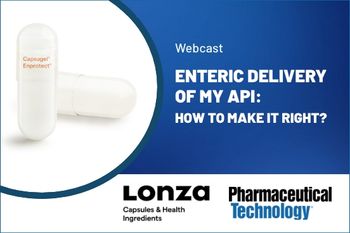
The enteric delivery of pharmaceuticals has long been a challenge for numerous reasons, including protecting the active pharmaceutical ingredients (APIs) from the harsh environment of the gastrointestinal tract and assuring consistent delivery and dosage in the small intestine. This paper reviews the challenges and the science that shows Lonza’s proposed hard capsule solution has been validated to provide acid protection, customization, and scalability.

Webcasts
Webinar Date/Time: Tue, Dec 5, 2023 11:00 AM EST
Sponsored Content
The Lonza Capsule Application Lab is uniquely focused on solving technical issues and creating new solutions related to dosage form and delivery. We work together to leverage our scientific and technical knowledge helping to improve your manufacturing process and methodology to deliver customized solutions.
Jet milling is a well-established particle engineering technique for producing micronized powders with controlled particle size distribution and increased surface area. This makes them suitable for inhalation drug delivery. However, successful implementation of jet milling requires a robust Quality by Design (QbD) approach that ensures the critical quality attributes of the micronized particles are maintained throughout the process development. This episode will cover the principles and intricacies of the jet milling process. It will also highlight some of the challenges when micronizing for inhalation delivery, and give some possible solutions. A case study will demonstrate a reliable process development strategy using a QbD approach for micronizing nilotinib, an API with potential for the treatment of severe chronic asthma. It will highlight the significance of implementing a QbD approach, and its benefits in process development. Overall, this presentation aims to provide valuable insights into the jet milling process and QbD approach for inhalation drug delivery and their potential applications in drug development.

Webcasts
Webinar Date/Time: Thursday, September 21, 2023 at 11am ET | 10am CT | 8am PT | 4 pm BST
Webcasts
Webinar Date/Time: Wed, Sep 20, 2023 11:00 AM EDT
The increasing number of breakthroughs in small molecule drug development are exciting, but corresponding workflows are complex and require much more tailored approaches to ensure successful upstream and downstream processing, drug approvals and commercialization.
Sponsored Content
International Journal of Pharmceutics: In Vitro: The dissolution characteristics of five capsules (Next Generation Enteric [NGE], Vcaps® Enteric [VCE], VCE DUOCAP® [VCE/VCE] system, Hard Gelatin Capsule [HGC] as negative control, and Creon® 10,000 U as market reference) were evaluated using an in vitro simulation of the stomach and upper intestinal tract with an acidic duodenal incubation (pH 4.5 for the first 10 min, pH 6 for the remaining 17 min) to simulate exocrine pancreatic insufficiency. Caffeine was a marker of capsule dissolution, and tributyrin to butyrate conversion measured pancrelipase activity. All capsules were filled with pancrelipase; the NGE, VCE, VCE/VCE, and HGC capsules also contained 50 mg caffeine. Caffeine was released first from the HGC capsule, followed by the VCE, NGE, and VCE/ VCE capsules. Pancrelipase activity followed this trend and demonstrated a similar activity level over time for the NGE, VCE/VCE, and Creon® capsules. The HGC formulation confirmed gastric degradation of unprotected pancrelipase. NGE capsules provided similar protection to the simple fill formulation as observed for the complex formulation of the Creon® capsule in a setting with increased pepsin activity and may hasten the time needed to go from formula development to first-in-human studies for pH sensitive drugs or those requiring small intestine targeting.
Sponsored Content
Introducing Lonza Capsules & Health Ingredients' groundbreaking enteric manufacturing technology - the Capsugel® Enprotect® capsule. This unique bi-layer capsule with the Coni-Snap® secure closure design utilizes HPMC and HPMC-AS polymers. It protects acid-sensitive APIs and enables rapid dissolution release at pH 6.8 without the need for additional excipients. The bi-layer manufacturing technology streamlines drug development processes, while personalized oral dose customization enhances product differentiation. Partner with us to revolutionize the microbiome market, overcome enteric delivery challenges, and drive innovation in modern healthcare.
Sponsored Content
Invivo: Many orally dosed APIs are bioavailable only when formulated as an enteric dosage form to protect them from the harsh environment of the stomach. However, an enteric formulation is often accompanied with a higher development effort in the first place and the potential degradation of fragile APIs during the coating process. Ready-to-use enteric hard capsules would be an easily available alternative to test and develop APIs in enteric formulations, while decreasing the time and cost of process development. In this regard, Lonza Capsugel® Next Generation Enteric capsules offer a promising approach as functional capsules. The in vivo performance of these capsules was observed with two independent techniques (MRI and caffeine in saliva) in eight human volunteers. No disintegration or content release in the stomach was observed, even after highly variable individual gastric residence times (range 7.5 to 82.5 min), indicating the reliable enteric properties of these capsules. Seven capsules disintegrated in the distal part of the small intestine; one capsule showed an uncommonly fast intestinal transit (15 min) and disintegrated in the colon. The results for this latter capsule by MRI and caffeine appearance differed dramatically, whereas for all other capsules disintegrating in the small intestine, the results were very comparable, which highlights the necessity for reliable and complementary measurement methods. No correlation could be found between the gastric residence time and disintegration after gastric emptying, which confirms the robust enteric formulation of those capsules
Sponsored Content
The Lonza Capsule Application Lab is uniquely focused on solving technical issues and creating new solutions related to dosage form and delivery. We work together to leverage our scientific and technical knowledge helping to improve your manufacturing process and methodology to deliver customized solutions.
Sponsored Content
Oral administration is the preferred route of delivery for therapeutic molecules due to its convenience. However, most New Chemical Entities (NCE) exhibit physico-chemical properties limiting their absorption in the gastrointestinal (GI) tract, with almost 70% of identified molecules facing solubility issues in aqueous GI fluids according to Pharmacircle data from March 2022. Lipid-based formulations (LBF) is an interesting approach to enhance oral bioavailability of poorly water-soluble (PWS) drugs, including small molecules and macromolecules such as peptides and proteins.

Webcasts
Webinar Date/Time: Thu, Sep 28, 2023 11:00 AM EDT
Sponsored Content
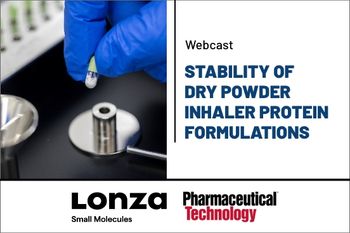
Biotherapeutics that allow for inhaled delivery and months of room-temperature stability are made possible with spray-drying techniques.
Sponsored Content
Successfully develop and commercialize new medicines with a highly accomplished collaborator.
Webcasts
Webinar Date/Time: Thu, Jun 15, 2023 11:00 AM EDT

A growing proportion of drugs in the development pipeline nowadays start out life at small biotech companies, rather than big pharma businesses. While this means the biotechs are taking on more risk, they will also reap greater rewards in the event of success. When it comes to choosing your CDMO partner, there is no substitute for a careful selection process to determine the right CDMO to make and manage your precious potential drug. In this podcast, David Hall, Senior Director, Commercial Development at Lonza Small Molecules, provides insights on how small and emerging pharmaceutical and biotech companies can navigate the evolving pharma development pipeline.
A growing proportion of drugs in the development pipeline nowadays start out life at small biotech companies, rather than big pharma businesses. While this means the biotechs are taking on more risk, they will also reap greater rewards in the event of success. When it comes to choosing your CDMO partner, there is no substitute for a careful selection process to determine the right CDMO to make and manage your precious potential drug. In this podcast, David Hall, Senior Director, Commercial Development at Lonza Small Molecules, provides insights on how small and emerging pharmaceutical and biotech companies can navigate the evolving pharma development pipeline.
Webcasts
Webinar Date/Time: Wed, Mar 1, 2023 11:00 AM EST
Webcasts
Webinar Date/Time: Thu, Feb 23, 2023 11:00 AM EST