
Equipment and Processing Report
Many facilities buy compressed gas tanks or evaporate liquid nitrogen to supply processes with dry, high-purity nitrogen. An in-house nitrogen generator, however, provides several significant benefits.
Equipment and Processing Report
Many facilities buy compressed gas tanks or evaporate liquid nitrogen to supply processes with dry, high-purity nitrogen. An in-house nitrogen generator, however, provides several significant benefits.
Equipment and Processing Report
Growing interest in continuous drug manufacturing has brought greater attention to in-line blending, a process that the petroleum and fine-chemicals industries have used for decades.
Equipment and Processing Report
We are making an emulsion using a high-shear in-line mixer. It?s a 60-gal batch, and it?s taking nearly an hour to get the results we?re looking for. We have tried changing the in-line mixer?s workheads to a two-stage configuration, but it doesn?t affect the mixing time. Where are we going wrong?
Equipment and Processing Report
PharmTech's monthly newsletter, Equipment and Processing Report, reviews the Editor's Picks for the February 2011 edition from Emerson Process Management and Spirax Sarco.
Japan has suspended the use of two pediatric vaccines made by Pfizer and sanofi following the deaths of four children in three days.
WuXi and BMS Form Collaboration; F. Michael Ball Leaves Allergan for Hospira; and More.
AstraZeneca announced this week that it will discontinue the production of Pulmicort (budesonide) 100 and 200 µg/dose HFA (hydrofluoroalkane) pressurized metered-dose inhaler (pMDI) due to manufacturing issues related to technical aspects of the device, which prevents the ongoing manufacture of the product.
FDA Posts PDUFA Meeting Minutes
At a conference on preserving national security at the University of Pittsburgh Medical Center last week, FDA Commissioner Margaret Hamburg stressed the importance of medical countermeasures for responding to natural and deliberate threats to public health.
The EMA has issued a statement addressing the withdrawal of the marketing authorization for Thelin, which was voluntarily withdrawn in 2010 because of a risk of serious liver injury.
Pharmaceutical Technology Europe
In France, public confidence in health authorities and pharmaceutical industry has been shaken by a safety scandal over the drug Mediator (benfluorex hydrochloride).
FDA announced on Mar. 2, 2011, that it is taking action against companies that manufacture, distribute, or market certain unapproved prescription oral cough, cold, and allergy products, according to an agency release.
Fujifilm and Merck & Co. have formed a definitive agreement by which Fujifilm will acquire the Merck BioManufacturing Network, a contract biopharmaceutical manufacturing and development business of Merck.
A number of European public health and transparency campaigners believe that conflict of interest rules may have been breached with the EMA's decision to allow its former Executive Director, Thomas Lönngren, to take up an advisory role within the private pharmaceutical sector.
The European Organization for Rare Diseases (EURORDIS), an alliance of patient organizations and individuals, celebrated its fourth Rare Disease Day on February 28.
FDA and Georgetown University Form Innovation Partnership
Pfizer Completes King Acquisition; ViiV Healthcare Names Chairman; and More.
Ongoing Free Trade Agreement (FTA) negotiations between the EU and India have hit a hurdle as some stakeholders urge the Indian government to fight against certain provisions in the FTA amid fears that access to generic drugs may be affected.
FDA recently sent sanofi-aventis two Warning Letters for its facilities in Frankfurt am Main, Germany, and Bridgewater, NJ.

What to do when your CMO changes the manufacturing equipment line.

Brazil develops its first national plasma fractionation plant.

A single, global tooling standard would offer many benefits, but one has been slow to emerge.
Social media tools have taken over many aspects of our lives, now including regulatory info.
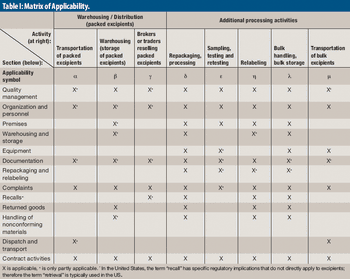
A new audit guide aims to improve supply-chain security and supplier qualification practice.
Just when things seem to be looking up, the unexpected problem occurs.
FDA's efforts to improve access to treatments for rare diseases.
INTERPHEX 2011 aims to address the industry's unique characteristics.
PTSM: Pharmaceutical Technology Sourcing and Management
A roundup of developments in corporate social responsibility and sustainability from the bio/pharmaceutical industry, its suppliers, and other public and private organizations.
PTSM: Pharmaceutical Technology Sourcing and Management
Bristol-Myers Squibb opens a new pediatric HIV/AIDS clinic in Tanzania.
PTSM: Pharmaceutical Technology Sourcing and Management
This article is Part I of a three-part series on biopharmaceutical issues in public health, government, and developing-world markets. Part 1 focuses on drug-development. Part II, which examines manufacturing, appeared in the April 2011 of Sourcing and Management. Part III, which analyzes distribution and administration,appeared in the May 2011 issue.