


The deadline to comment on FDA's generative AI paper is Oct 19, 2026. We explain why professionals in pharma manufacturing should weigh in.
The deadline to comment on FDA's generative AI paper is Oct 19, 2026. We explain why professionals in pharma manufacturing should weigh in.

The FDA expanded Anktiva to BCG-unresponsive papillary-only NMIBC using existing CIS trial data, a precedent with implications for development timelines and supply planning.

AI accountability, faster FDA pathways, rare disease CMC review, and next-gen GLP-1 formulation lead this week’s PharmTech roundup.

Ishani Maharaj of Ingredients + Specialties from Univar Solutions explains how to stabilize GLP-1 multi-agonists, weigh delivery formats, and qualify novel excipients and suppliers.

MASH and cardiomyopathy AI collaboration: AstraZeneca pays insitro $40M upfront for target discovery, then leads clinical development and CMC planning.
Boyang Wang, Immortal Dragons, discusses how the FDA’s Expedited IND Pilot must prove efficiency as sponsors chase the fastest route to valid first-in-human data.
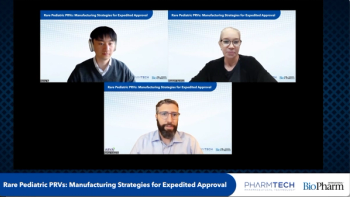
Nate Edwards of Arya Consulting moderates a discussion with Elisabeth Gardiner of Tevard Biosciences and Donny Xu of the RTW Institute about rare disease treatment development and navigating the FDA’s Rare Pediatric Disease Priority Review Voucher Program.
The FDA’s Rare Disease Framework Initiative brings risk-based CMC review and pre-approval inspections into scope for sponsors, CDMOs, and quality teams.

NVIDIA’s $250M, five-year compute donation funds UK agentic AI safety research, with implications for how GMP teams validate and govern autonomous AI.
Jaenisch, Muraru, and Pandey join PharmTech's Cole to discuss FDA's generative AI paper, ARPA-H's SURPASS trials, and AI accountability.

Richard Jaenisch explains what FDA's real-world use case database means for CMC and quality teams navigating NAMs.
Boyang Wang, Immortal Dragons, explains how FDA’s Expedited IND Pilot and research partners could speed serial steps to first-in-human trials compared to China’s 818 Decree.

This article examines how modern automation platforms create the digital foundation required for Pharma 4.0 by integrating manufacturing systems, centralized data management, Industrial Internet of Things connectivity, electronic batch production records, and AI-driven analytics.
PharmTech AI Pulse Check panelists explain why attribution, audit trails, and sign-off matter more than AI watermark detection for GxP quality teams.

Ron Scarboro, Azurity Pharmaceuticals, explains how cross-functional development, disciplined reformulation, and post-approval metrics can help proven medicines work in everyday use.
The FDA approves oral pritelivir for drug-resistant herpes sores in immunocompromised patients; what it means for antiviral development and manufacturing.

This week, drug formulation and manufacturing experts showcased their knowledge, and companies exhibited their products, at CPHI Milan.

FDA approves Teva’s Weltruza, a once-monthly subcutaneous olanzapine for schizophrenia whose copolymer depot eliminates post-injection monitoring.

Equivalence test using two one-sided tests are widely used for demonstrating the comparability of treatment effects in different research fields. The method described in the manuscript aims to use simulations in Microsoft Excel to compute power for 2 one-sided tests for two groups with unequal variances.
Richard Jaenisch examines whether FDA's NAM pathway truly shortens drug pipelines or just shifts the evidentiary burden elsewhere.

Susan J. Schniepp, distinguished fellow with Nelson Labs, and Siegfried Schmitt, PhD, vice president, Technical, with Parexel, clear up some of the confusion about what does and does not need to be complied with regarding standards set by international pharmacopoeias.
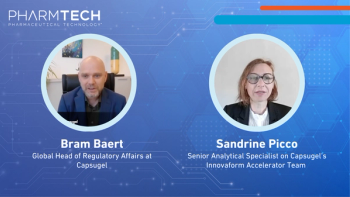
Mitigating nitrosamine risk requires assessing each product individually, says Bram Baert, Global Head of Regulatory Affairs at Capsugel, and Sandrine Picco, Senior Analytical Specialist on Capsugel's Innovaform Accelerator Team, in this interview with PharmTech.

Jason Bertola, executive director of Commercial Development for the Advanced Synthesis Platform at Lonza in North America, explains the demand for spray drying and the hurdles involved with scale up, in an interview with PharmTech.
API-gated journals may skew pharma regulatory research as AI agents favor accessible sources, raising citation integrity and pharmacovigilance risks.

The FDA has approved remibrutinib for symptomatic dermographism, the first such therapy, extending an oral BTK inhibitor label via the Phase III RemIND trial.

The company is showcasing new development solutions and advanced digital technologies including its new OSD Express and Steriles Express solutions for drug development.
Ron Scarboro, Azurity Pharmaceuticals, explains when formulation robustness justifies added cost and which post-approval quality and supply metrics teams can track.

The winners of the CPHI Pharma Awards 2026 include a neurodegeneration platform, a track-and-trace packaging innovation, a enzymatic mRNA manufacturing technology, and a cell-free enzymatic biomanufacturing platform.
Richard Jaenisch explains why NAMs are compressing drug development faster than AI and what FDA's new nonclinical testing rule means for sponsors.
Shadow AI and vendor data retention put GMP records and trade secrets at risk. AI Pulse Check panelists outline what pharma AI policies require.