
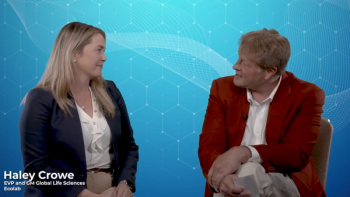
Hayley Crowe, executive vice-president and general manager Global Life Sciences at Ecolab discussed at BIO 2024 how technology innovations have enhanced downstream bioprocessing.
Hayley Crowe, executive vice-president and general manager Global Life Sciences at Ecolab discussed at BIO 2024 how technology innovations have enhanced downstream bioprocessing.

The drug manufacturing ecosystem Pharma 4.0, a term coined in 2017 by the International Society for Pharmaceutical Engineers, promises a revolution across drug discovery, manufacturing, and supply chain logistics, ensuring drugs are delivered precisely when needed, and improving overall patient care.

Lilly has added a $1 billion investment to increase biologics manufacturing at its Limerick, Ireland, site while unveiling its new $800 million facility in Kinsale.

The company said this new commitment to its facility in Germany goes hand in hand with its recently announced ReciPredict, an initiative intended to streamline the product development cycle.

Novo Nordisk will use Korro Bio’s OPERA platform to develop RNA editing candidates for two targets to treat cardiometabolic diseases.

The critical APIs that this funding will contribute to are used in the treatment of asthma, diabetes, and anxiety disorders.
Descon Conveyor Systems is joining Pacteon’s portfolio, and its product will be shown alongside those from Schneider Packaging Equipment and Phoenix Stretch Wrappers.
Seventeen biologics and nine tides—five peptides and four oligonucleotides—were approved in 2023 alone, with further growth predicted.
Sartorius' new Vivaflow SU tangential flow filtration cassette offers better flexibility in lab workflows and is designed to be more user-friendly.
During a presentation at the PDA/FDA Joint Regulatory Conference, Nicholas Violand of Johnson & Johnson and Paul Palmer of Paul R. Palmer Limited discussed how aging facilities can impact the quality of pharmaceutical products.
The 2024 CPHI Pharma Awards comprise finalists spanning 14 categories and includes awards for future leaders, women of the year, and an “at the heart of pharma” category.
CDER’s Jonathan Chapman, senior policy advisor, and Takeda’s Paulien Groll, head of Compliance Excellence, discussed how companies can be proactive with their CAPA strategies instead of reactive, at the 2024 PDA/FDA Joint Regulatory Conference.

This Behind the Headlines news roundup panel discussion covers news items such as the weight loss drugs battle between Novo Nordisk and Eli Lilly, entering new territory through Lilly’s partnership with HAYA Therapeutics and long non-coding sequence mining. There was much discussion on how the inflation reduction act and Medicare price controls may or may not pertain—given the uncertainty around the presidential election results, and subsequent policy directions. The Centers for Disease Control making cost free COVID-19 diagnostics and therapies available was also evaluated.
Rentschler Biopharma has expanded its service offerings at its Stevenage, UK, site with a new lentiviral vector manufacturing toolbox.
Among the design features of the machine is software-based tracking that is meant to ensure that products that are temperature-sensitive do not exceed their time limit in the solution.

A coordinated and international response is needed to help control the latest mpox outbreak in Africa.

Bio/pharma companies should be approaching their decarbonization journey as a strategic business move for the future as industry stakeholders are placing greater value on sustainability.
The approach makes use of clinical mass spectrometers that are already available in hospitals around the world.
This is the company’s largest single investment in the Sweden Biomanufacturing Center, in Södertälje, which opened in 2021.
Phase III trial results showed that Imfinzi (durvalumab in combination with chemotherapy reduced the risk of recurrence, progression, or death by 32% in patients with resectable non-small cell lung cancer before and after surgery.
The completed acquisition of Morphic expands Lilly's immunology pipeline with Morphic's oral integrin therapies for treating inflammatory bowel disease.
PiaSky (crovalimab) has previously been approved in countries such as the United States and Japan for monthly, subcutaneous use that may be self-administered with adequate training.
Opaganib was given orphan drug designation for the treatment of neuroblastoma in children, which is rare, but the most common infancy malignancy.
In a 24-week study of patients with PAH, six-minute walking distance improved by an average of 40.8 meters, and risk of death or clinical worsening was reduced by 82%.

The collaboration builds on Novartis’ acquisition of Chinook Therapeutics just over a year ago.
The approvals and authorizations come amid a late summer surge in the virus that is tracking a bit earlier than the early fall wave in the US in 2023.
Merck, known as MSD outside of the United States and Canada, will gain CN201, a next-generation bispecific antibody, from Curon Biopharmaceutical in a deal potentially worth up to $1.3 billion.

Vernal Biosciences’ CEO and founder, Christian Cobaugh, discusses the outsourcing landscape for mRNA production.

In this episode of the Ask the Expert video series, Susan J. Schniepp, distinguished fellow at Regulatory Compliance Associates, and Siegfried Schmitt, vice president, Technical at Parexel, discuss submitting biologics license applications and working with suppliers.
The combination of Opdivo plus Yervoy is already established as a second-line treatment for patients with advanced hepatocellular carcinoma.