





Manufacturing
Latest News
November 6th 2026
CDMOs, OEMs, and Used Equipment Resellers are Joining Forces to Onshore Pharmaceutical Manufacturing
Onshoring pharmaceutical manufacturing can be made more practical by collaborating with CDMOs that have gray space, supported by strong relationships with used equipment dealers and OEMs.
Advertisement
Review of SUT Adoption in Biopharma Manufacturing
The evolution of therapeutic modalities drives the adoption of single-use technologies.

Why Are Pharmaceutical Companies Reluctant to Adopt Cloud Technologies?
Despite its understandable hesitancy, the pharma industry is facing a need for more widespread adoption of cloud-based solutions.

Automating the Future of Fill/Finish
Given the criticality of fill/finish processes, it is clear that automation is the next technological step.

Latest Videos


Shorts
0:33
How To Fix A Broken Supply Chain
a day ago
by
Zachary Zubulake(+1 more)
0:46
Why Drug Shortages Are Getting Harder To Fix
2 days ago
by
Zachary Zubulake(+1 more)

0:35
The Checklist to Validate AI in GMP Enviorments
6 days ago
by
Manish Baviskar
0:46
AI vs. Traditional Software in Pharma
9 days ago
by
Manish Baviskar
0:31
New Solutions to the Drug Recall Crisis
15 days ago
by
Zachary Zubulake(+2 more)
1:01
How to Stop the Next Nitrosamine Drug Recall
17 days ago
by
Zachary Zubulake(+2 more)
0:42
The Hidden Danger in Generic Antidepressants
20 days ago
by
Zachary Zubulake

0:35
Efficiency vs. Reliability
a month ago
by
Ron Scarboro(+2 more)

0:20
Accelerating Drugs with Predictive Modeling
a month ago
by
Jason Bertola(+1 more)
0:18
The Right Way to Build New Medicines
a month ago
by
Ron Scarboro(+2 more)
Advertisement
More News

Continuous overall equipment effectiveness can be used to pinpoint hidden downtime and process bottlenecks in real time.

The PharmTech team focused on its coverage of AAPS PharmSci 360 this week, conducting interviews with experts on a range of topics including formulation platforms, AI, amorphous solid dispersions, and animal studies.
The agreement between CDER and OII with allow for coordinated marketing application assessments and inspections.

Shubhajit Paul, a senior research fellow in Boehringer Ingelheim’s Department of Material Analytical Sciences, spoke with PharmTech at AAPS PharmSci 360 to explain how tabletability prediction can be improved for roller-compacted formulations.

This week on PharmTech.com, experts discussed E&L suitability standards, rare disease treatment development, sourcing ingredient suppliers, the use of AI in quality control, and more.

Cole and Jaenisch dig into AI poisoning in pharma manufacturing, how it hides in plain sight, and who should be accountable for catching it.

Mahmood Majeed, ZS, explains why measurable AI outcomes in pharma supply chain and manufacturing jumped from 29% to 53%, and how GMP limits and GxP validation shape adoption.

FDA approves GSK's bepirovirsen for chronic hepatitis B after a 19% functional cure rate, raising oligonucleotide scale-up stakes for manufacturers.
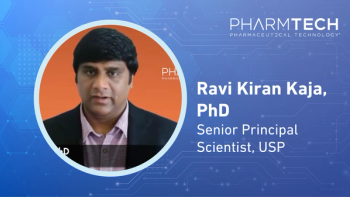
Ravi Kiran Kaja, PhD, USP, explains what harmonization of extractables and leachables standards looks like in practice.
Nine duloxetine recalls since 2024 show why generic drug manufacturers need route-level nitrosamine risk assessment, not end-product testing alone.
Ravi Kiran Kaja, PhD, explains how USP’s industry-wide initiative aims to build confidence in trace-level extractables and leachables results.

AI accountability, faster FDA pathways, rare disease CMC review, and next-gen GLP-1 formulation lead this week’s PharmTech roundup.

MASH and cardiomyopathy AI collaboration: AstraZeneca pays insitro $40M upfront for target discovery, then leads clinical development and CMC planning.
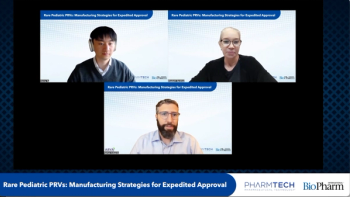
Nate Edwards of Arya Consulting moderates a discussion with Elisabeth Gardiner of Tevard Biosciences and Donny Xu of the RTW Institute about rare disease treatment development and navigating the FDA’s Rare Pediatric Disease Priority Review Voucher Program.

NVIDIA’s $250M, five-year compute donation funds UK agentic AI safety research, with implications for how GMP teams validate and govern autonomous AI.
Advertisement
Advertisement
Trending on Pharmaceutical Technology
1
Signs Point to FDA Shelving Priority Voucher Pilot, Stalling Fast-Track Drug Reviews
2
Our Biggest Takeaways From AAPS PharmSci 360
3
$1.15B AI-Guided Macrocycle Discovery Lands at argenx
4
Pimicotinib TGCT Approval Shows How Assessment Aid Supports Review
5