The US Food and Drug Administration's Center for Drug Evaluation and Research executed 45 Class I, 193 Class II, and 128 Class III recalls of human drugs between Oct. 1, 2005 and Sept. 30, 2006.

The US Food and Drug Administration's Center for Drug Evaluation and Research executed 45 Class I, 193 Class II, and 128 Class III recalls of human drugs between Oct. 1, 2005 and Sept. 30, 2006.

CPhI Worldwide, Paris (Oct. 3)-The Synthetic Organic Chemical Manufacturers Association and the European Fine Chemicals Group have teamed to urge US and European regulatory authorities to increase inspections of foreign manufacturing facilities of active pharmaceutical ingredients (APIs) to reduce patient risk from sub-par drugs, to increase national security, and to level the economic playing field.

Rockville, MD (Oct. 2)-The US Food and Drug Administration has issued its final Guidance for Industry: Quality Systems Approach to Pharmaceutical CGMP Regulations.

Missouri City, TX (Oct. 3)-The US District Court for the Western District of Texas denied the Department of Justice?s motion to alter its Aug. 30 decision that the US Food and Drug Administration does not have the ability to regulate drug compounding.

Rockville, MD (Sept. 28)-The US Food and Drug Administration has released the draft guidance for industry ?Characterization and Qualification of Cell Substrates and Other Biological Starting Materials Used in the Production of Viral Vaccines for the Prevention and Treatment of Infectious Diseases.?

Rockville, MD (Sept. 28)-The US Food and Drug Administration has withdrawn three guidances for industry: ?Providing Submissions in Electronic Format?NDAs? (e-NDA), ?Providing Regulatory Submissions in Electronic Format?ANDAs? (e-ANDA), and ?Providing Regulatory Submissions in Electronic Format: Annual Reports for NDAs and ANDAs.? These documents all recommend submitting information as portable document files (PDFs) or as SAS transport files.

The specialty excipients market in the United States, Western Europe, and China is valued at nearly $800 million. The authors discuss the opportunities and challenges in these markets by examining the product mix, supply base, and preferred production methods.

A recent analysis found that 9000 marketed drugs are not in FDA's National Drug Code Directory.

GlycoFi's work could eliminate the need for mammalian cell culture and improve the performance of protein therapies.

Getting "swamped at work" takes on an entirely new meaning for these GMP Agents.

Developed in the 1950s as a means to survive and compete against the giants of the automotive sector, lean manufacturing helped Toyota evolve from a small-volume producer (with little capital) to become a high-volume manufacturer in a process-rich environment. Toyota achieved this by using developments such as total production maintenance (TPM), just-in-time (JIT), Kanban, value stream mapping and Kaizen events.1 A summary of some of the lean terminology is shown in Table 1.

It will remain to be seen whether pharmaceutical companies will commit lock, stock and barrel to being green.

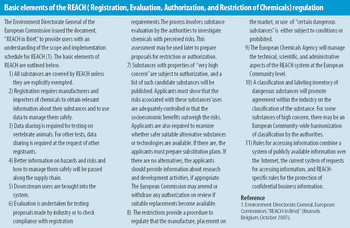
The Bulk Pharmaceuticals Task Force (BPTF), an affiliate organization of the Synthetic Organic Chemical Manufacturers Association (SOCMA, Washington, DC) submitted a citizen petition to the US Food and Drug Administration (Washington, DC) requesting the agency to increase inspections of drug manufacturing facilities located outside of the United States.

Washington, DC (Sept. 26): A much-publicized Institute of Medicine report, "The Future of Drug Safety: Promoting and Protecting the Health of the Public," though devoted to the assessment and perception of risk, focuses on premarketing clinical reviews and postmarketing pharmacovigilance. It does not address or make recommendations on drug manufacturing or quality assurance.

Kevin Sharer has become chairman of the board of the Pharmaceutical Research and Manufacturers of America upon the resignation of Peter R. Dolan.

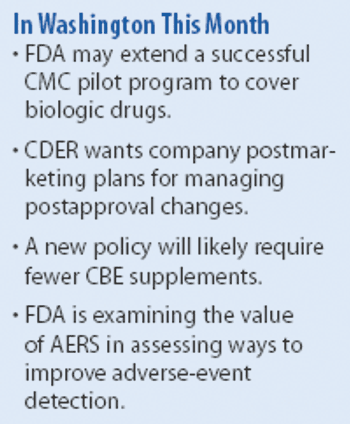
Washington, DC (Sept. 12)-The Office of New Drug Quality Assessment (ONDQA) in the Center for Drug Evaluation and Research (CDER) has approved one new drug application (NDA) under its CMC Pilot Program and has two more applications are under review. The pilot was established last year to provide an opportunity for FDA and industry to explore strategies for including Quality by Design (QbD) principles and process analytical technology approaches in regulatory submissions, explained ONDQA deputy director Chi-wan Chen at the PDA-FDA Joint Regulatory Conference here

Washington, DC (Sept. 1) - In a Federal Register announcement the US Food and Drug Administration laid out its guidance agenda for the coming months.

As the pace of product development accelerates, the approach to dissolution-method development must advance beyond a manual method and an assay. A natural progression of the method-development process must include the transfer of the manual method onto automated instrumentation.

Before formal cleaning validation programs were instituted, visual inspection was the primary means of determining equipment cleanliness. The use of visual inspection is still typically a component of a cleaning validation program and for routine inspections of cleaning effectiveness, but the use of visual inspection as a sole criterion for equipment cleanliness has not been successfully implemented as a valid approach for cleaning validation.

I recently embarked on a quest: to investigate industry's use of the words, "generic" and "biosimilar" when describing a biologic molecule. An English major at heart, I was wrapped up in a news story that was partly about science, partly about words.

FDA will strengthen its collaborative relationships with federal agencies participating in the National Nanotechnology Initiative.

Apparently, the inspector would sneak off to visit his relatives on FDA time, instead of visiting us.

Partnerships launched 63 research projects that may translate into nine or 10 new drugs by 2010.

Now is the time to get ahead of the learning curve and explore options for meeting pedigree guidelines.

Implementing an electronic system to track out-of-specification results could help ensure compliance with current good manufacturing practices, but the system must be 21 CFR Part 11 compliant and easy to install, maintain, and use.