PharmTech LCGC Sciex Webinar 11.10
News|Videos|November 9, 2026

PharmTech’s Weekly Roundup—November 6, 2026: Impurities, Supply Resilience, and AI Accountability

Author(s)Susan Haigney

Coverage from AAPS PharmSci 360 and CPHI Milan featured discussion about impurities, devices, and supply resilience. This week also included topics such as AI accountability, oral peptides, and new licensing deals.

This week, PharmTech continued its coverage from AAPS PharmSci 360 and CPHI Milan. The focus kept coming back to one idea: in drug development, the costliest problems are the ones that were not addressed early enough, from impurity gaps to device mismatches to shortages that drag on for years. Regulators and industry leaders are now asking the same pointed question of artificial intelligence (AI), data, and supply chains: who is accountable, and can they prove it?

In the News…

In news this week, FDA’s accelerated approval of INOVIO’s VOCERYQ, a plasmid DNA-based immunotherapy—the first DNA medicine the agency has approved—sets a precedent for nonviral plasmid products made by fermentation and puts drug-device combination controls at the center of commercial readiness.

Four cross-border licensing deals were made this week covering antibody drug conjugates (ADCs), a molecular glue degrader, and a gut-restricted agonist, each bringing new tech transfer and scale-up demands for chemistry, manufacturing, and controls (CMC) teams. Specifically, Boehringer Ingelheim and Sino Biopharmaceutical (SBP Group) announced an option and license agreement covering 6 preclinical ADC and T-cell engager programs.Nxera Pharma granted AbbVie exclusive worldwide rights to NXE0033744, an oral EP4 receptor agonist for inflammatory bowel disease. Minghui Pharmaceutical granted ASKA Pharmaceutical exclusive rights in Japan to MHB018A, a subcutaneous antibody targeting insulin-like growth factor 1 receptor (IGF-1R) for thyroid eye disease. And, Evommune in-licensed rights outside Greater China to EVO570, an oral molecular glue degrader from Hinova Pharmaceuticals.

In Conference Coverage…

At AAPS PharmSci 360, Veranova’s Subathra Ramamoorthy explained why forced degradation for potent APIs can’t be a checklist exercise: when OEB 4 and 5 compounds are handled in tiny amounts inside isolators, any carryover shows up directly in the results. Ramamoorthy also explained why impurity deficiencies keep repeating in submissions, advising sponsors to tell one consistent story for each impurity and to review their filings as if they were the agency reviewer.

The US Pharmacopeia’s (USP’s) Catherine Sheehan and Tong (Jenny) Liu described the tools USP is building to clear the novel excipient roadblock, including a weight-of-evidence safety approach and emerging standards, and urged makers to engage early.

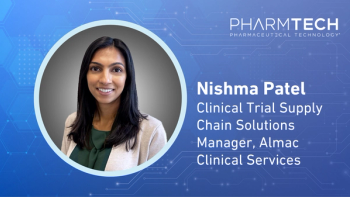
Almac Clinical Services’ Nishma Patel described how the CPHI Award-winning just-in-time Almac Adapt approach holds off packaging and labeling until each ultra-rare gene therapy patient is confirmed ready, protecting scarce, irreplaceable doses.

In Expert Commentary….

Evocon’s Breandán Flood argued that continuous overall equipment effectiveness (OEE) monitoring can show manufacturers which aging assets to replace, which to retrofit, and which to leave alone.

In Cynthia Challener’s latest development article, experts agreed that no single structural modification will make peptides orally bioavailable, and that stability, permeability, potency, and manufacturability have to be optimized together.

Partha S. Anbil and Anoop Sidharthan argued that most life sciences data problems are really ownership problems, and proposed a data mesh where domain experts answer for the definitions and quality of the data they publish.

Brian Drapeau explained that the business case for regulated AI depends on the cost per accepted outcome, not the cost of generating output, because the real costs sit in review, change control, and quality-unit capacity.

In this month’s AI Pulse Check, Richard Jaenisch, Florin Muraru, and Gourav Pandey warned that inspectors will judge companies against their own AI policies, so clear ownership, documented use, and AI literacy have to come first.

And on PharmTech Explained, Zach Zubulake takes a look at the state of drug shortages, including USP’s 2025 drug shortages report. In the video, USP’s Ronald Piervincenzi provided commentary, explaining why the average drug shortage now lasts more than five years, calling it an incentive problem: the market doesn’t pay for reliability.

And finally, check out the October Regulatory Roundup for the latest on regulatory actions from the US and Europe.

Whether the subject is impurities, devices, data, AI, or supply, this week’s message was the same: build in accountability and cross-functional thinking early, because fixing it later always costs more. For the full stories, visit PharmTech.com.
Related to this article