News|Articles|December 12, 2017

In the Lab eNewsletter

  • Pharmaceutical Technology\'s In the Lab eNewsletter-01-10-2018
  • Volume 13
  • Issue 1

SGS Adds GMP DNA Sequencing Capabilities at Glasgow Facility

SGS has introduced a Sanger sequencing service at its Glasgow, United Kingdom, laboratory to support genetic stability testing and perform identity testing on cell banks, plasmids, and viral seeds/vectors.

SGS, a provider of bio/pharmaceutical, analytical, and bioanalytical solutions, has introduced a Sanger sequencing service at its Glasgow, United Kingdom, laboratory to support genetic stability testing and perform identity testing on cell banks, plasmids, and viral seeds/vectors. The service is now available under good manufacturing practice (GMP) conditions to clients from December 2017.

Sanger sequencing is a method of DNA sequencing based on the selective incorporation of chain-terminating deoxynucleotides by DNA polymerase during in-vitro DNA replication. Applications include cell bank characterization, virus seed and plasmid identity testing, and genetic stability testing of cell banks. The new service is supported by an investment in ABI Life Technologies’ validated 3500xl DNA sequencing technology and will complement existing services for this testing, to provide comprehensive analysis and characterization solutions for clients involved in the production and manufacturing of biopharmaceutical products.


The Glasgow facility became part of SGS in 2012 following the acquisition of biopharmaceutical contract testing organization Vitrology Limited, which specializes in biosafety testing. An expansion of the facility in 2014 added an additional 500 m² of laboratory space.

SGS has 20 laboratories offering contract analytical and bioanalytical services across in North America, Europe, and Asia. The company delivers harmonized solutions to large pharmaceutical and biotechnology firms. In addition to testing services for the bio/pharmaceutical market, SGS also provides Phase I­–IV clinical trial management, and services encompassing data management and statistics, pharmacokinetic/pharmacodynamic modeling and simulation, pharmacovigilance, and regulatory consultancy.

Source: SGS


Related to this article

Glass vial, pipette and woman scientist in laboratory for medical study, research or experiment. Test tube, dropper and professional female person with chemical liquid for pharmaceutical innovation. | Image Credit: ©HockleyMedia24/peopleimages.com -stock.adobe.com
Equivalence test using two one-sided tests are widely used for demonstrating the comparability of treatment effects in different research fields. The method described in the manuscript aims to use simulations in Microsoft Excel to compute power for 2 one-sided tests for two groups with unequal variances.
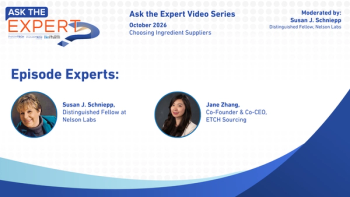
Ask the Expert: Choosing Ingredient Suppliers
Jane Zhang of ETCH Sourcing explains why geopolitics, transparency, and partnership now weigh as heavily as cost and quality when companies choose suppliers, in this episode of Ask the Expert, moderated by Susan J. Schniepp of Nelson Labs.