

The company was cited for cGMP violations at its Irvine, California facility.
The company was cited for cGMP violations at its Irvine, California facility.
The agency met with the representatives of the East African Community to discuss the creation of a networking agency.
CBER is moving forward with the development and approval of regenerative medicine advanced therapies.
FDA cited the facility for violations of quality management and data integrity CGMPs.
FDA’s new commissioner asks staff for suggestions for fighting the opioid crisis.
The agency has given a green light to a new system for collecting and monitoring suspected adverse reactions.
The agency is warning drug manufacturers about Burkholderia cepacia complex after product recalls due to contamination.
PTSM: Pharmaceutical Technology Sourcing and Management
A recent survey suggests that 36% of pharmaceutical companies and contract development and manufacturing companies have not started working on serialization, and that those who are working on it are focusing on basic compliance rather than potential long-term business benefits.
PTSM: Pharmaceutical Technology Sourcing and Management
Due to weak penalties and lax enforcement, illicit pharmaceuticals continue to slip into the US, European and global supply chains.
The agency released several new and revised guidance documents regarding product-specific generic drug development.
Archana M. Akalkotkar, PhD, research scientist I at Charles River, discusses the use of process validation to ensure quality.
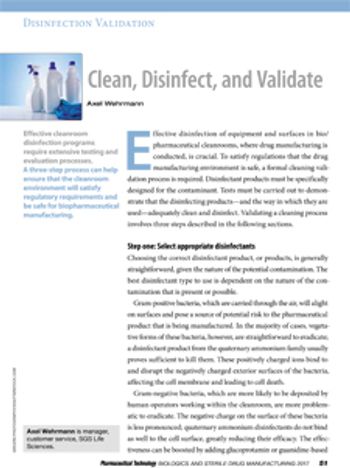
Effective cleanroom disinfection programs require extensive testing and evaluation processes. A three-step process can help ensure that the cleanroom environment will satisfy regulatory requirements and be safe for biopharmaceutical manufacturing.
A multi-pronged approach to raw materials testing can help mitigate the risk of future contamination events.
The existing, obsolete highpurity water generation system and water-forinjection generation system were replaced with new, reliable technologies.
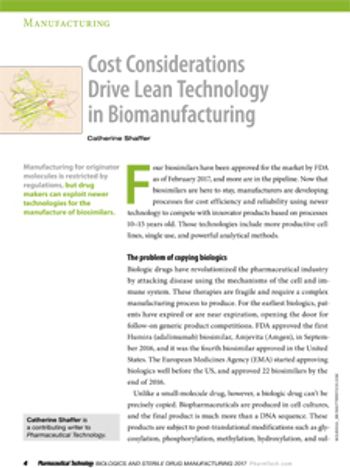
Manufacturing for originator molecules is restricted by regulations, but drug makers can exploit newer technologies for the manufacture of biosimilars.
FDA sent a warning letter to the company in India for delaying and limiting an FDA inspection in addition to problems related to cGMP.
Equipment and Processing Report
At CPhI North America 2017, the US Pharmacopeial Convention will be discussing its upcoming revision and modernization of the standards for elemental and organic impurities.
FDA hopes to better use global resources and avoid duplicate inspections of foreign facilities.
The company is expanding their April 2017 voluntary recall of phenobarbital tablets.
The agency released its report on pilot project to involve patients in the assessment of medicines.
FDA sent a warning letter to Pharmaceutic Labs, LLC for deficiencies in producing sterile drugs.
User fee reauthorizations, a hiring freeze, and opioid epidemic await the new FDA commissioner Scott Gottlieb.
Many pharmaceutical companies are sceptical about IDMP despite the business benefits and its contribution to patient safety.
The Identification of Medicinal Products (IDMP) standards requires regulatory teams to efficiently collate data from multiple sources and functions.
A rigorous approach to industrial security is essential for protecting intellectual property and product integrity in connected pharmaceutical operations.