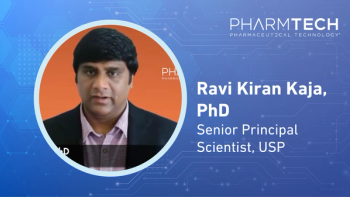
Ravi Kiran Kaja, PhD, explains how USP’s industry-wide initiative aims to build confidence in trace-level extractables and leachables results.
Ravi Kiran Kaja, PhD, USP, explains what harmonization of extractables and leachables standards looks like in practice.
Ahead of AAPS PharmSci 360, PharmTech spoke with Ravi Kiran Kaja, senior principal scientist at the United States Pharmacopeia (USP), about how extractables and leachables (E&L) assessment differs by dosage form and what harmonization of E&L standards means in practice.
The scientific principles of E&L testing stay the same, explains Kaja, but the risks and technical challenges vary across dosage forms. Parenteral and ophthalmic products need very sensitive assessments because materials may come into direct contact with highly sensitive tissues. Inhalation and nasal products are more complex because the device itself often becomes part of the product system. Transdermal and topical products can involve complex formulations, adhesives and long-term contact with packaging. That is why a one-size-fits-all approach does not work in E&L science. Instead, testing must be tailored to the product, the route of administration, patient exposure, and the materials of construction. USP’s dosage form–specific chapters reflect this. As Kaja puts it, the analytical tools may be similar, but the scientific questions are different.
When it comes to harmonization, laboratories worldwide should produce data that are scientifically comparable and equally trusted. Harmonization relies on agreement on terminology, study design, analytical expectations, reference materials, and standards. It also takes collaboration among regulators, industry, standards organizations, and scientists. USP provides documentary standards, physical reference materials, scientific leadership, and forums for collaboration. Its System Suitability Initiative is one example. Harmonization, he stresses, is not uniformity; it is building global confidence in the quality of data.
Kaja will be presenting recent USP developments in E&L standards and complex products at AAPS PharmSci 360, and will be moderating the presentation, Seeing Inside the Dose: Predictive Drug Development with Microstructure Intelligence, which will be held on Wednesday, October 28.
More about this keynote session:
AAPS PharmSci 360: Microstructure Intelligence in Predictive Drug Development, Part 1
AAPS PharmSci 360: Microstructure Intelligence in Predictive Drug Development, Part 2