Is the recent round of Big Pharma plant closings a sign of regrowth?

It's time for the pharmaceutical industry to consider electronic innovations as part of their life cycle management strategies.

Merck (Whitehouse Station, NJ, www.merck.com) has revealed the "first phase" of its global restructuring program set to eliminate 7000 jobs (11% of its global workforce) by the end of 2008, close or sell 5 of its 31 manufacturing facilities, and roll out a manufacturing strategy to "drive significant efficiencies, decrease headcount, and reduce or refocus operations throughout the plant network and the entire manufacturing division." The company also expects to close one basic research site and two preclinical development sites.

A particular dermatological product was packaged in a metal tube, which is filled from the bottom.

Amgen Losing Hold on Anemia Drug Market

Bristol-Myers Squibb to Cut Costs by $500 Million

Roche Selects 12 Potential Manufacturing Partners for Tamiflu

SEC Loosens Revenue-Recognition Rules for Vaccine Stockpile Participants

NIAID Boosts Vaccine Innovation but Draws Controversy

FDA Warns Consumers Against Unapproved, Contaminated 'Miracle II Neutralizer'

This year's fall conference season clearly shows that the new, systematic approach to process planning and product quality is permeating the industry's thinking—if not yet its daily practice.

A new oral dosage product was designed as "encapsulated tablets." In production, the drug product was pressed into tablets, which were then fed into a revolving capsule-filling table.

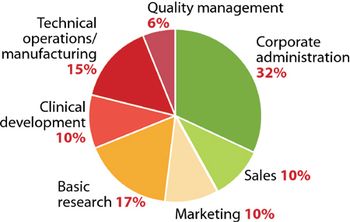
From politics to paychecks and downsizings to deadlines-what it's like to work for one of the world's largest industries.

If judges and juries lack the scientific knowledge to decide drugsafety cases, how can we protect both companies and patients?

Roche (Basel, Switzerland, www.roche.com) has put a temporary halt on the distribution of the antiviral treatment, "Tamiflu" (oseltamivir phosphate), a neuraminidase inhibitor, to the United States in an effort to deter companies from stockpiling the antiviral for employee use, according to an article in the Oct. 27 edition of The New York Times.

First, a confession. Yes, the four sleep-deprived editors hunched behind glowing laptops in the Opryland Resort's Cyber Café last month were indeed from this publication. Normally, our mumbled conversations about punctuation and grammar take place before 11:00 pm—and under slightly lower systemic levels of caffeine, sugar, and sushi.

The attraction of nasal administered therapeutic agents is obvious, including faster onset of action, increased compliance and avoiding degradation during first pass metabolism.

With the prospect of a possible pandemic the Swiss company, Roche, has found sales of its flu drug have rapidly increased but its patent is being questioned. Roche's Tamiflu sales have inflated by 263% in the first 9 months of this year but discussions of patent suspension from several countries and United Nations Secretary General Kofi Annan is pressurizing the company.

The introduction of new measures on advertising and promotional materials for prescription medicines could delay UK launches. The Medicines and Healthcare products Regulatory Agency (MHRA) has admitted that the checks, which have been introduced in response to a Commons' Health Select Committee report, could extend a launch by at least 2 weeks.

The monopoly held by the large pharmaceutical companies within drug discovery could be falling into the hands of biotechnology firms claims Frost and Sullivan. The consultancy company's report, Biochips Technology Redefines Process of Drug Discovery, states that biochip manufacturers are encouraging end users to accept the new technology by providing novel and effective solutions.

OTC Eye-Drop Maker Signs Consent Decree

Merck to Close Plants, Slash Jobs, Streamline Manufacturing

American Pharmaceutical Partners to Merge with American BioScience

GSK Study Questions Bioequivalency of Generic Cold Sore Creams

Pfizer to Shut Parsippany Plant

Adjuvant for HPV Vaccine Enhances Immune Response Levels

Chiron Looks to Flu Vaccine Cell Culture; FDA Gears Up

Continuous manufacturing processes?little used in the pharmaceutical industry but the norm in oil, food, chemical, and polymer manufacturing?go hand-in-hand with the current emphasis on quality-by-design and automated process monitoring and control (aka, process analytical technology, PAT).

The process analytical technology (PAT) initiative has been percolating at the US Food and Drug Administration for a long time, explained FDA's John E. Simmons at the AAPS Annual Meeting and Exposition on Wednesday. "If you think of PAT as an isolated set of applications, I think you are missing the point," Simmons said. "The FDA would like PAT to become commonplace?not to be an initiative, but common practice."

This week, the US Food and Drug Administration posted an Oct. 20 Warning Letter (http://www.fda.gov/foi/warning_letters/g5567d.htm) sent by its Minneapolis, MN district office to Diversified Manufacturing Corporation (Newport, MN).