

PTSM: Pharmaceutical Technology Sourcing and Management
Double-digit growth is projected for the US generic drug market, and the industry positions for opportunities in biosimilars.
PTSM: Pharmaceutical Technology Sourcing and Management
Double-digit growth is projected for the US generic drug market, and the industry positions for opportunities in biosimilars.
PTSM: Pharmaceutical Technology Sourcing and Management
Pfizer CentreSource is proceeding with a new plan for the supply of steroids and steroid intermediates through a recently signed pact with two Asian contract manufacturing organizations.

Nanotechnology is emerging as a tool for resolving challenges in delivering poorly water soluble and highly potent drugs.
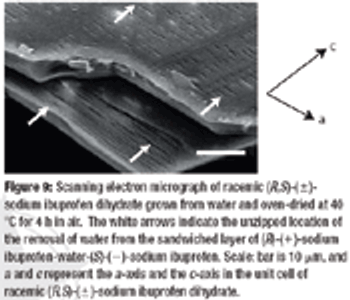
The racemic compound (R, S)-(±)-ibuprofen is a popular and well understood active pharmaceutical ingredient, but it has several disadvantageous formulation properties such as poor solubility, low melting point, and potential esterification with excipients containing an hydroxyl group. The authors investigate the use of an (R, S)-(±)-ibuprofen salt to evaluate these problems using various analytical methods to determine the polymorphism, crystallinity, and drying scheme.
Pharmaceutical Technology Europe
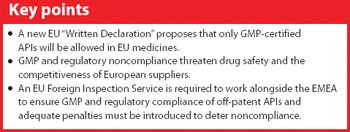
The Active Pharmaceutical Ingredients Committee (APIC) - a sector group of Conseil European des Federations de l'Industrie Chimique (CEFIC) - first voiced the need for EU GMP API legislation in 1993 to help ensure the safety of medicines. In 2000, the International Conference on Harmonisation (ICH) finalized the harmonized API GMP Guideline Q7, which became legal in the US and Japan in 2001. The EU adopted a directive in March 2004 that includes the requirement for APIs in medicines for the EU market to comply with ICH/Q7A. Member States are transposing the directive into their national law: about half of them have completed this process, seven more are well on their way to completion, while seven others are still in earlier stages of adoption.
Pharmaceutical Technology Europe
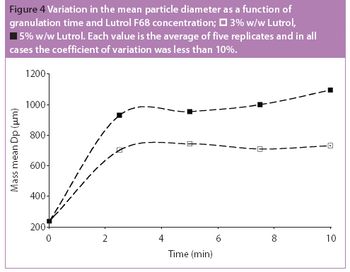
Fluidized hot melt granulation (FHMG) is an emerging technique combining the advantages of both dry and wet granulation methods, and represents an innovative continuous granulation process capable of mixing and agglomerating excipients and active pharmaceutical ingredients (APIs) to produce uniform blends of particles suitable for use in the manufacture of pharmaceutically elegant solid dosage forms.
Pharmaceutical Technology Europe
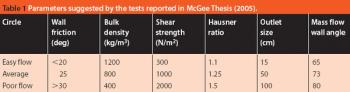
Predicting the flow characteristics of powders during manufacture is especially important for the pharmaceutical engineer. Getting the powder flow wrong can be highly disruptive to plant performance and productivity, particularly where equipment has to be taken off-line and stripped down for cleaning out blockages. The flow behaviour of the individual ingredients may be well known, but as these are blended and reacted their flow properties can change.
PTSM: Pharmaceutical Technology Sourcing and Management
Reflecting strong growth prospects for certain biologic-based drugs, the biotechnology and pharmaceutical majors are proceeding with a strategy of expanding their internal manufacturing networks and partnering with select contract manufacturing organizations (CMOs).
ePT--the Electronic Newsletter of Pharmaceutical Technology
Boston, MA (May 8)-The global biotechnology industry showed several positive signs in 2006, including increases in overall revenues and financing, although the industry as a whole continues to operate at a loss, according to Ernst & Young's annual analysis of the biotechnology industry.
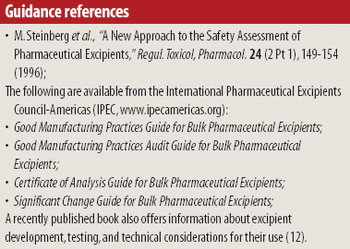
Excipients facilitate formulation design and perform a wide range of functions to obtain desired properties for the finished drug product. The article reviews excipient development and functionality of these materials, including their importance in formulation design, potential processing challenges directly related to excipients, and therapeutic benefits.
The pharmaceutical majors build their capabilities in peptide technology, and contract manufacturers expand to meet growing demand for bulk peptides.
Pharmaceutical Technology Europe
Green chemistry involves redesigning processes so that more of the raw material ends up in the product, rather than as waste...
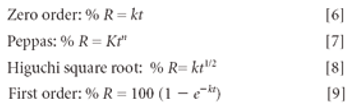
Hydrogels are biocompatible drug delivery systems by which the physical properties can be controlled by the cross-linking density. Hydrogels were prepared by copolymerization of acrylic acid monomers in the presence of poly(ethylene glycol)(PEG) to form polyethylene diacrylate (PEDGA). Various molecular weights of PEGs were used for the synthesis of PEGDA to study the effect of molecular weight of PEG on the properties of hydrogels. These hydrogels were further characterized for free water, swelling behavior, water diffusion, drug loading, and drug release profile. By analyzing the swelling behavior and release pattern of the hydrogels, the authors show that these systems can be suitably used for controlled delivery of drugs.
Pharmaceutical Technology Europe
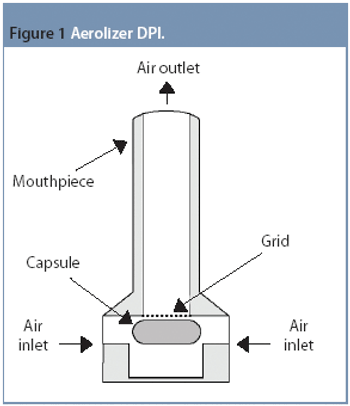
There have been significant advances, especially in understanding the role of carrier properties on the aerosol performance of the API.
Pharmaceutical Technology Europe
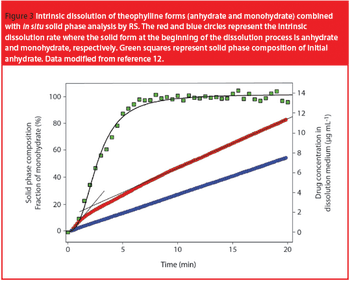
When a dosage form or an API is introduced to the gastrointestinal tract, or dissolution media mimicking it, a transformation from a metastable to a more stable form with lower solubility and bioavailability is possible.
ePT--the Electronic Newsletter of Pharmaceutical Technology
Midland, MI (Mar. 21)-The Dow Chemical Company formed an alliance with Colorcon, Inc. for the global marketing, sales, technical service and development, and distribution of Dow pharmaceutical excipient products for use in controlled-release applications.
PTSM: Pharmaceutical Technology Sourcing and Management
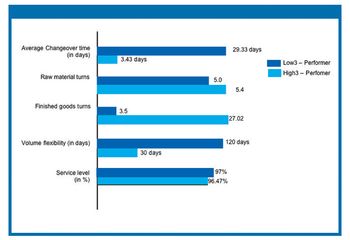
Improving performance at an active pharmaceutical ingredient manufacturing plant involves an integrated approach that incorporates methods for optimizing total production management, quality control and assurance, and inventory management. The authors analyze results from a recent benchmarking study to evaluate the critical success factors in high-performing API manufacturing plants.
ePT--the Electronic Newsletter of Pharmaceutical Technology
Rockville, MD (Mar. 1)-Sending Warning Letters to 8 manufacturers and 12 distributors, The US Food and Drug Administration ordered a stop to the manufacture and distribution of unapproved drug products containing ergotamine tartrate.

The pharmaceutical supply chain lengthens as generic drug manufacturers build production platforms offshore and CMOs position in India and China to meet demand for lower-cost production.
The low-volume pharmaceutical industry must adapt Lean Manufacturing tools invented for high-volume, single product industries.
ePT--the Electronic Newsletter of Pharmaceutical Technology
Brussels (Feb. 13)-The European Generic Medicines Association raised concerns over what it terms ?the serious lack? of resources available to member states in the European Union (EU) to deal with the regulatory workload and bottleneck in new registrations caused by the new Decentralized Procedure (DCP) for approving drugs in Europe.
ePT--the Electronic Newsletter of Pharmaceutical Technology
London (Feb. 22)-AstraZeneca unveiled further details of its plan to reduce staff at certain production facilities and announced a $120-million investment in a new process research and development (PR&D) facility in the United Kingdom.
PTSM: Pharmaceutical Technology Sourcing and Management
Continuing an ambitious growth strategy, SAFC eyes CGMP manufacturing capacity in India for its custom-synthesis business and seeks to gain large-scale organics manufacturing capacity in China for raw-materials supply. And, its biosciences segment seeks opportunity in single-use disposable manufacturing.

PTSM: Pharmaceutical Technology Sourcing and Management
As the supply-chain strategies of the pharmaceutical industry evolve, managing risks in outsourcing takes on greater importance. A recent program by the Drug, Chemical, and Associated Technologies Association examined approaches to mitigating risk and improving the pricing-and-cost model in the outsourced relationship.
ePT--the Electronic Newsletter of Pharmaceutical Technology
InformexUSA, San Francisco (Feb. 14?16)-Several contract manufacturing organizations (CMOs) and technology providers used InformexUSA to announce plans to expand manufacturing capabilities, increase service offerings, and ramp up other investments.