






Manufacturing
Latest News
Advertisement
Review of SUT Adoption in Biopharma Manufacturing
The evolution of therapeutic modalities drives the adoption of single-use technologies.

Why Are Pharmaceutical Companies Reluctant to Adopt Cloud Technologies?
Despite its understandable hesitancy, the pharma industry is facing a need for more widespread adoption of cloud-based solutions.

Automating the Future of Fill/Finish
Given the criticality of fill/finish processes, it is clear that automation is the next technological step.

Latest Videos





Shorts
1:01
How to Stop the Next Nitrosamine Drug Recall
2 days ago
by
Zachary Zubulake(+2 more)
0:42
The Hidden Danger in Generic Antidepressants
5 days ago
by
Zachary Zubulake

0:35
Efficiency vs. Reliability
16 days ago
by
Ron Scarboro(+2 more)

0:20
Accelerating Drugs with Predictive Modeling
19 days ago
by
Jason Bertola(+1 more)
0:18
The Right Way to Build New Medicines
20 days ago
by
Ron Scarboro(+2 more)

0:14
The 'Zero Nitrite' Myth in Pharma
22 days ago
by
Bram Baert(+1 more)

0:50
Why One Good Supplier Isn't Enough to Fix Drug Shortages
23 days ago
by
Ronald T. Piervincenzi(+2 more)
0:29
Why We Have Drug Shortages and How to Fix Them
a month ago
by
Ronald T. Piervincenzi(+2 more)
0:39
Building Resilience in the Global Supply Chain
a month ago
by
Ronald T. Piervincenzi(+2 more)

0:24
Reducing R&D Experiments by Orders of Magnitude with AI
2 months ago
by
Alfred Rumondor, PhD(+1 more)
Advertisement
More News

This article examines how modern automation platforms create the digital foundation required for Pharma 4.0 by integrating manufacturing systems, centralized data management, Industrial Internet of Things connectivity, electronic batch production records, and AI-driven analytics.

Ron Scarboro, Azurity Pharmaceuticals, explains how cross-functional development, disciplined reformulation, and post-approval metrics can help proven medicines work in everyday use.

FDA approves Teva’s Weltruza, a once-monthly subcutaneous olanzapine for schizophrenia whose copolymer depot eliminates post-injection monitoring.
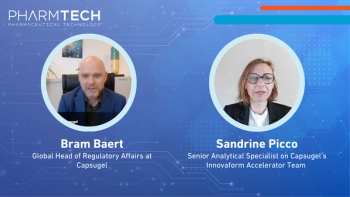
Mitigating nitrosamine risk requires assessing each product individually, says Bram Baert, Global Head of Regulatory Affairs at Capsugel, and Sandrine Picco, Senior Analytical Specialist on Capsugel's Innovaform Accelerator Team, in this interview with PharmTech.

Jason Bertola, executive director of Commercial Development for the Advanced Synthesis Platform at Lonza in North America, explains the demand for spray drying and the hurdles involved with scale up, in an interview with PharmTech.
Ron Scarboro, Azurity Pharmaceuticals, explains when formulation robustness justifies added cost and which post-approval quality and supply metrics teams can track.

The winners of the CPHI Pharma Awards 2026 include a neurodegeneration platform, a track-and-trace packaging innovation, a enzymatic mRNA manufacturing technology, and a cell-free enzymatic biomanufacturing platform.

Richard Jaenisch explains why NAMs are compressing drug development faster than AI and what FDA's new nonclinical testing rule means for sponsors.
Hovione's $35M CDC Flex line links spray drying to tablets, designed to eliminate scale-up under FDA Q13 guidance.

This week on PharmTech, Merck diversified its pipeline, USP emphasizes supply chain security, AI systems are examined, and speakers preview their presentations at CPHI Milan and AAPS PharmSci 360.
Ron Scarboro, Azurity Pharmaceuticals, claims drug reformulation that removes patient barriers must preserve efficacy, urging early cross-functional team alignment.

Novartis licenses Abogen's mRNA-encoded T-cell engager for autoimmune disease, raising scale-up questions for mRNA-lipid nanoparticle manufacturing.
Ron Scarboro, Azurity Pharmaceuticals, explains why real-world usability belongs at product definition and how post-launch feedback should guide drug formulation.

Ronald Piervincenzi, USP, explains why drug supply resilience needs a system approach, from procurement benchmarks to regulatory capacity building.

Gene manufacturing platforms, patient-centric formulations, contract services, packaging innovations, and sterile filling lines are in the spotlight at CPHI Milan 2026.
Ronald Piervincenzi, USP, explains why drug supply resilience needs a system approach, from procurement benchmarks to regulatory capacity building.
Richard Jaenisch weighs how FDA's new NAM rule could reshape preclinical testing and what CMC teams should do now, on Manufacturing Intelligence.

In a preview of their panel discussion at AAPS PharmSci 360 2026, Alfred Rumondor, PhD, AbbVie, and Swita Singh, PhD, Bristol Myers Squibb, discuss the implementation of risk-based approaches for CMC.
Ronald Piervincenzi, USP, urges drugmakers and purchasers to act on supply chain resilience to curb drug shortages and shape better policy.

Content on PharmTech.com this week ranged from fundamentals on the use of digital pathology in drug development, discussions on the use of AI in pharma, and regulatory actions impacting the industry.
Ronald Piervincenzi, USP, explains why manufacturers should act now and how benchmarking could reward reliable generic drug suppliers.

The FDA approves Lilly's once-weekly insulin efsitora for type 2 diabetes, raising Fc-fusion manufacturing, high-concentration pen, and capacity questions.

The agency issued a direct final rule that supports the use of innovative testing methods to limit the use of animals and maintain existing safety standards.

The FDA approves Inluriyo-Verzenio combo for ESR1-mutated breast cancer; EMBER-3 data double PFS, with supply chain and diagnostics implications for manufacturers.

The Leadership Summit will bring senior pharma executives together to discuss supply chain resilience, medicine security, and manufacturing capacity amid growing geopolitical fragmentation.
Advertisement
Advertisement
Trending on Pharmaceutical Technology
1
Pharma Leaders Weigh in On AI's Measurable Results In 2026
2
Humanitas Global Health Launces at AAPS PharmSci 360 Event
3
Manufacturing Intelligence: How AI Poisoning Hides in Plain Sight
4
Formulation and Evaluation of a Sustainable Analgesic Cream Utilizing Renewable Bio-Based Ingredients and Green Chemistry Design Principles
5