



Prosecutors and regulators challenge manufacturing quality failings likely to cause patient harm.

Prosecutors and regulators challenge manufacturing quality failings likely to cause patient harm.
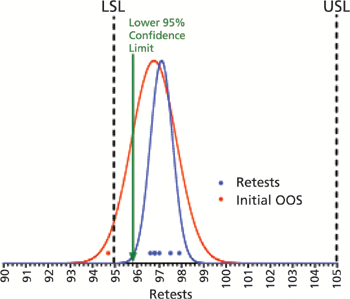
Two methods to evaluate retest data following out-of-specification results.

A thorough investigation of all possible causes of deviations should be performed.

The US Pharmacopeial Convention contiues to make modernization of standards a top priority in 2013.
Protecting patients from counterfeit medicines is a pressing issue facing governments and the pharmaceutical industry.

Recent activity in standards-setting organizations has raised interest in the impact of testing for impurities that may enter the product before it is mined or harvested or even due to intentional use of some reagents.

Adherence to GMP in API manufacturing is crucial in determining the safety of drug products.
Two general chapters on elemental impurities? limits and procedures are to become official Feb. 1, 2013, with implementation proposed for May 1, 2014.
EMA announces collaboration with Israel, and USP updates chapter on elemental impurities.

Ben Venue Laboratories announced that it has voluntarily entered into a consent decree with FDA over violations of cGMP.
FDA has issued a Warning Letter to Hameln Pharmaceuticals GmbH after observing "significant" cGMP violations for finished pharmaceuticals at the company?s facility in Hameln, Germany.
FDA has released Guidance for Industry: Abuse-Deterrent Opioids?Evaluation and Labeling, Draft Guidance
Eli Lilly expects overall revenue growth in the coming year.
FDA celebrates 30 years of the Orphan Drug Act.
USP's focus in 2013 involves standards relating to organic impurities, measurement of residual DNA and host-cell proteins in biotechnology products, and elemental impurities.

Additional approvals in December have helped to outpace a recent high set in 2011.

The health ministry of Brazil recently signed an agreement to obtain its production technology to locally develop the antiretroviral drug atazavanir sulfate.

Pharmaceutical Technology Europe
FDA talks about the changing scope of regulatory science and its effect on drug reviews, site inspections, overall approaches.

The EU fine-tunes legislation for the Falsified Medicines Directive, which is due to take effect this month as part of efforts to better protect patients from counterfeits.

Siegfried Schmitt, a principal consultant with PAREXEL, discusses the EMA's guideline on process validation and how it compares with FDA's process validaton guidance.

Revalidation of cleanroom disinfection may be unnecessary, according to John S. Kent.

Shortages and compounding disaster spur efforts to overhaul manufacturing oversight and stimulate industry improvements.
Chapter 2.9.40 of the European Pharmacopeia is the binding requirement for dosage uniformity. Recently, an additional alternative chapter 2.9.47 has been created titled "Demonstration of Uniformity of Dosage Units using large Sample Sizes".
The US Pharmacopeia (USP) is examining the issue of uniformity of dosage units to address whether scoring yields consistent split doses. Anthony DeStefano, Ph.D., senior vice-president, general chapters and healthcare quality standards, provides an overview of the USP's work in this area.

Tablet splitting is a new area of focus for regulators. The FDA tells PTE more about the challenges in this area.