

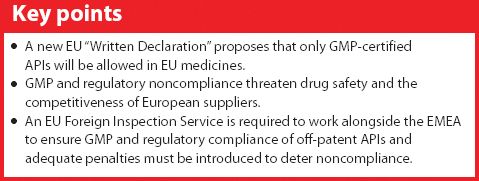
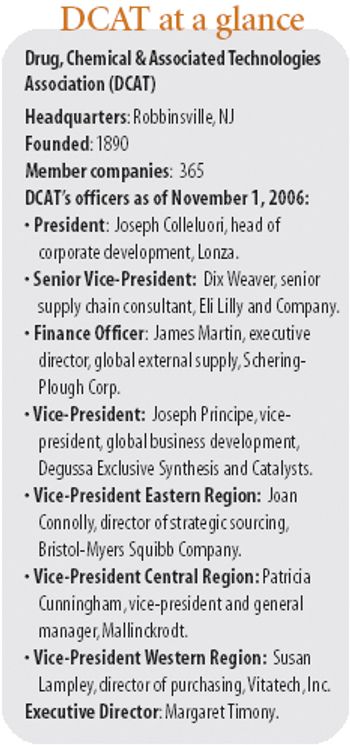
The Drug, Chemical & Associated Technologies Association (DCAT) serves as a link between sourcing and procurement professionals in the pharmaceutical industry and suppliers of pharmaceutical ingredients.
The Drug, Chemical & Associated Technologies Association (DCAT) serves as a link between sourcing and procurement professionals in the pharmaceutical industry and suppliers of pharmaceutical ingredients.
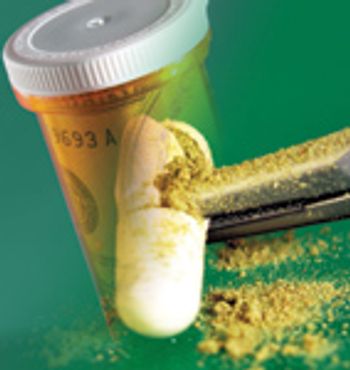
Disappointed in progress thus far, the US Food and Drug Administration wants pharmaceutical manufacturers to make a greater effort to combat counterfeit products and recommends that they "move quickly" to implement radio-frequency identification technology.

ePT--the Electronic Newsletter of Pharmaceutical Technology
The UK Medicines and Healthcare Products Regulatory Agency (MHRA, London) has reissued its recall of a specific batch of counterfeit ?Lipitor? 20-mg tablets. MHRA, in conjunction with Pfizer (New York City, NY), first issued the recall of batch number 004405K1 in July 2005. The new recall is in response to the discovery of more packages of the counterfeit drug in the United Kingdom.
ePT--the Electronic Newsletter of Pharmaceutical Technology
A group of researchers from Georgia Institute of Technology (Atlanta, GA) are using high-throughput ionization techniques to identify and measure the ingredients in counterfeit drugs.
Microsoft Corporation (Redmond, WA) announced the winners of the Microsoft Pharmaceuticals and Life Sciences Innovation Awards 2006 at this year?s meeting of the Drug Information Association in Philadelphia, Pennsylvania. A four-person panel of industry experts selected winners for the innovative use of Microsoft products in pharmaceutical and life sciences business processes and practices.
ePT--the Electronic Newsletter of Pharmaceutical Technology
The US Food and Drug Administration?s Counterfeit Drug Task Force (Rockville, MD, www.fda.gov) is recommending regulatory actions and the implementation of new technologies for reducing the risk of counterfeit drugs entering the United States. The group has followed up on its original 2004 report, in which it outlined the framework for protecting the public from counterfeit medicines, and an updated 2005 report with a third document encouraging electronic pedigrees, improved traceability in the drug supply chain, and the adoption of radio-frequency identification (RFID) tools.
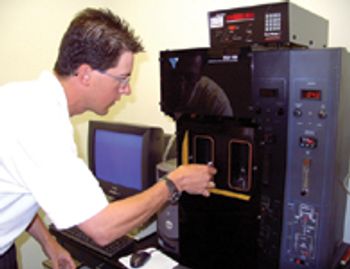
Interphex provided an opportunity to examine the latest pharmaceutical packaging concepts and packaging machines.
ePT--the Electronic Newsletter of Pharmaceutical Technology
RFID and the Future of Pharmaceutical Supply Chains
ePT--the Electronic Newsletter of Pharmaceutical Technology
Proposed Legislation to Help Fight Counterfeit Drugs
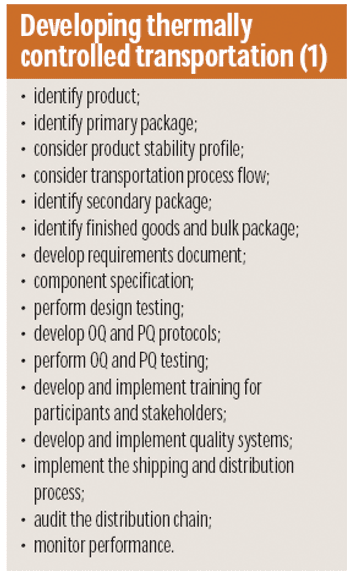
PDA's Technical Report No. 39 provides guidance for protecting temperature-sensitive products.
ePT--the Electronic Newsletter of Pharmaceutical Technology
Pfizer Combats Counterfeiters with RFID
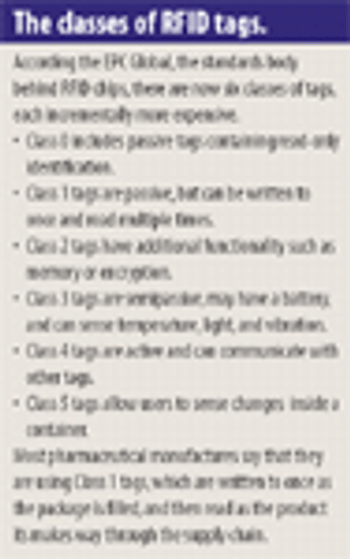
A fleet of pharmaceutical manufacturers have green lighted new bar coding and e-pedigree pilots using electronic barcodes. But is Industry ready for full-scale RFID?
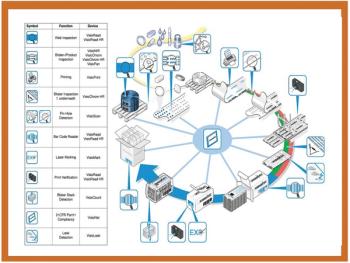
Most experts recommend layering protective technologies by selecting a combination of overt and covert techniques.
RFID and battery-powered containers are among the developments receiving attention in the pharmaceutical cold chain.
FDA relies on e-chips to thwart bogus products, and drops paper pedigrees and unit-of-use packaging.
FDA and manufacturers seek to curb drug counterfeiting while legislators consider liberalizing drug importing policies to cut pharmaceutical costs.
Brand and product security technologies offer pharmaceutical manufacturers anticounterfeiting solutions.
Near-infrared spectroscopy is a sophisticated and selective technique that has emerged as a powerful tool for the analysis of pharmaceuticals.