

Pharmaceutical Technology Europe
How can any company be sure that the standards that suppliers might claim to operate, and might be able to demonstrate from time to time, are actually being practised all the time?
Pharmaceutical Technology Europe
How can any company be sure that the standards that suppliers might claim to operate, and might be able to demonstrate from time to time, are actually being practised all the time?

PTSM: Pharmaceutical Technology Sourcing and Management
As part of a larger effort to address drug counterfeiting, the European Commission is seeking to tighten manufacturing and related supply-chain requirements for active pharmaceutical ingredients.
Pharmaceutical Technology Europe
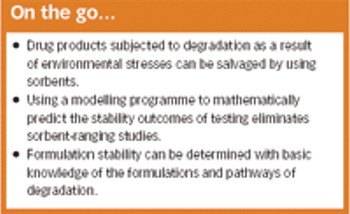
Drug products subjected to degradation because of environmental stresses can be salvaged if proper packaging and protection is provided by sorbents.
ePT--the Electronic Newsletter of Pharmaceutical Technology
The European Federation of Pharmaceutical Industries and Associations (EFPIA), the trade association representing European pharmaceutical manufacturers, issued recommendations to the public consultation launched in March by the European Commission's proposed drug anticounterfeiting measures. EFPIA's proposal includes a ban on drug repackaging.
PTSM: Pharmaceutical Technology Sourcing and Management
The recent heparin contamination event calls for a new approach to manage a lengthening pharmaceutical supply chain.
ePT--the Electronic Newsletter of Pharmaceutical Technology
Researchers from the Georgia Institute of Technology described a fast method to detect counterfeit "Tamiflu," Roche's drug for preventing and treating bird flu.
The recent heparin contamination event calls for a new approach to manage a lengthening pharmaceutical supply chain.
Sophisticated replication techniques have made counterfeiting and fraud a serious threat to the pharmaceutical industry.
Pharmaceutical Technology Europe

Pharmaceutical Technology Europe
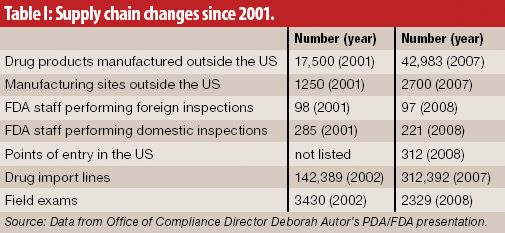
Manufacturing facilities must be inspected by members of regulatory bodies. However… these bodies are woefully inadequate at performing the task.
PTSM: Pharmaceutical Technology Sourcing and Management
Draft federal legislation that would require high-risk chemical facilities to use inherently safer technology for reducing their risk may present potential problems for custom and batch manufacturers supplying the pharmaceutical industry.

Pharmaceutical Technology Europe
How much do you know about parallel trade? Perhaps you may have heard someone mention these words and have then switched off. In a sense, it's hardly surprising given the fact that most media coverage centres on interpretation of complex legal cases. By the time you reach the end of these types of articles, you can't work out what the mentioned companies were arguing about in the first place and on which technical details the case was judged. Yet, time after time, a legal ruling on a parallel trade issue rockets to the front pages of the pharmaceutical press and even, occasionally, the mainstream media.
Pharmaceutical Technology Europe
Never has greater pressure been applied to pharmaceutical manufacturers. Shelf space competition for branded drugs has reached aggressive proportions and now even prescription drugs vie for pricing and delivery. Against this is a backdrop of ever-increasing downward price pressures, and a spectrum of progressively more stringent legislative and quality requirements. Finally, regional markets now demand different tamper evidence technology, anticounterfeiting measures and safeguards against interference by biological terrorists. Much of which points to the need for innovation in packaging - not just in terms of pack styles and sizes, but also cost.

Information technology is the glue that should unify a company while ironically, it enables further fragmentation. Experts talk about the successes and challenges for IT in helping a company function efficiently.
Pharmaceutical Technology Europe
Pharmaceutical manufacturers are under increasing pressure to shorten time-to-market, produce treatments with unpredictable product lifetimes, provide greater flexibility and, at the same time, comply with ever more stringent quality, validation, stability and traceability constraints. While this is encouraging for the contract manufacturing sector, it creates the need for even greater manufacturing flexibility.
Pharmaceutical Technology Europe
The recently published Orange Guide 2007 contains significant changes to the GMP requirement placed on pharmaceutical manufacturers, but there have been additional changes to good distribution practice that should not be overlooked.
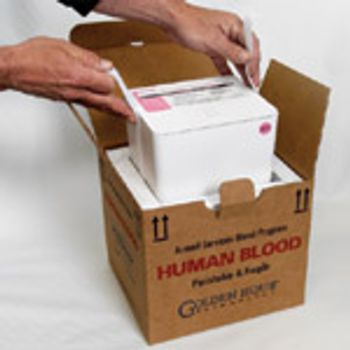
Makers of temperature-sensitive products constantly seek to ensure proper conditions during shipping and storage.
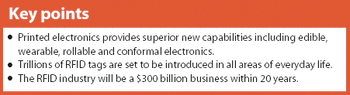
Pharmaceutical Technology Europe
Drug companies have come to realize that spending heavily on creating new blockbuster drugs is risky and less cost-effective ...
Pharmaceutical Technology Europe
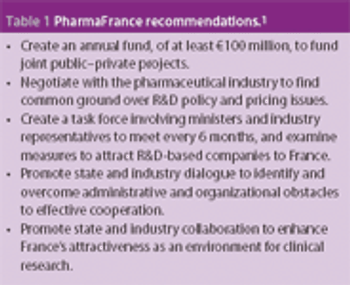
Driven by a rapidly ageing population and a known high consumption of pharmaceuticals, the French pharmaceutical market has always appeared buoyant.
ePT--the Electronic Newsletter of Pharmaceutical Technology
Brussels (May 30)-The European Federation of Pharmaceutical Industries and Associations (EFPIA) called for the pan-European and industry-wide adoption of 2-D barcode technology to combat the increase in counterfeit drugs in Europe.
Pharmaceutical Technology Europe
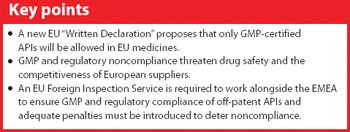
The Active Pharmaceutical Ingredients Committee (APIC) - a sector group of Conseil European des Federations de l'Industrie Chimique (CEFIC) - first voiced the need for EU GMP API legislation in 1993 to help ensure the safety of medicines. In 2000, the International Conference on Harmonisation (ICH) finalized the harmonized API GMP Guideline Q7, which became legal in the US and Japan in 2001. The EU adopted a directive in March 2004 that includes the requirement for APIs in medicines for the EU market to comply with ICH/Q7A. Member States are transposing the directive into their national law: about half of them have completed this process, seven more are well on their way to completion, while seven others are still in earlier stages of adoption.
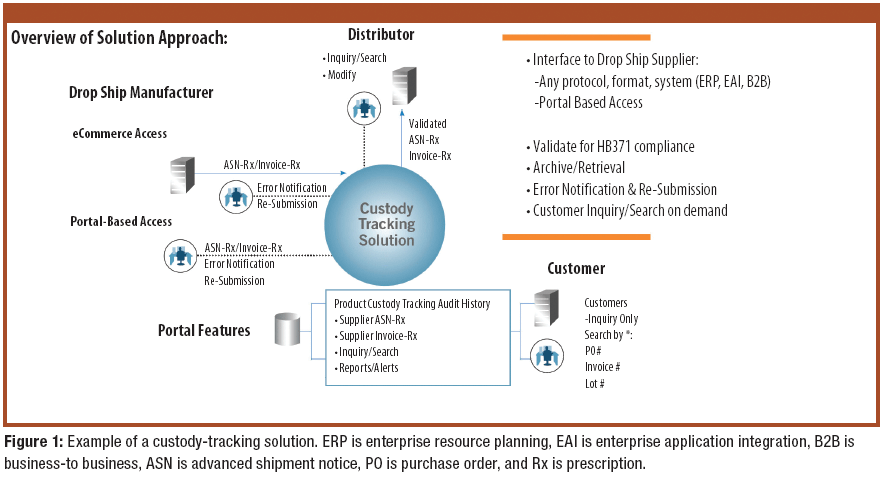
Interphex2007, New York, NY (Apr. 26)-Counterfeit medicines are of increasing concern to the pharmaceutical industry, both because of the potential health risks to patients and because of the effects on pharmaceutical companies' businesses. While technology such as e-pedigree and radio frequency identification (RFID) represent solutions to secure the supply chain, there are challenges.
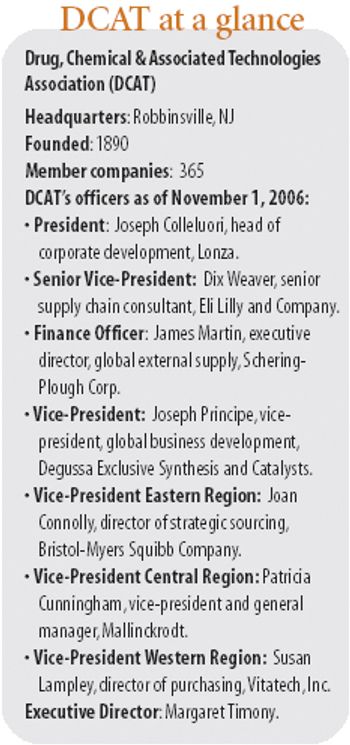
The Drug, Chemical & Associated Technologies Association (DCAT) serves as a link between sourcing and procurement professionals in the pharmaceutical industry and suppliers of pharmaceutical ingredients.
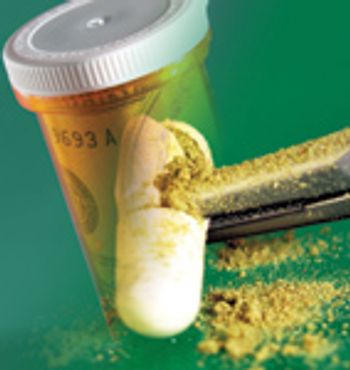
Disappointed in progress thus far, the US Food and Drug Administration wants pharmaceutical manufacturers to make a greater effort to combat counterfeit products and recommends that they "move quickly" to implement radio-frequency identification technology.
ePT--the Electronic Newsletter of Pharmaceutical Technology
The UK Medicines and Healthcare Products Regulatory Agency (MHRA, London) has reissued its recall of a specific batch of counterfeit ?Lipitor? 20-mg tablets. MHRA, in conjunction with Pfizer (New York City, NY), first issued the recall of batch number 004405K1 in July 2005. The new recall is in response to the discovery of more packages of the counterfeit drug in the United Kingdom.