
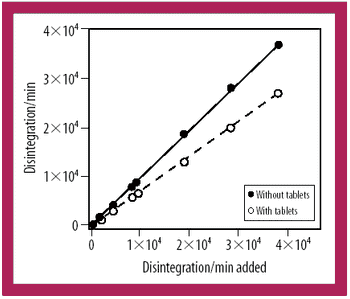
A radiotracer technique is a simple, fast, and sensitive technique for analyzing the integrity of clinical supply packages to water.
There is a great need for sensitive, precise, and easily accessible analytical detection techniques for protein sequencing.

The emergence of mRNA vaccines and cell and gene therapies has pushed innovation in analytical methods.
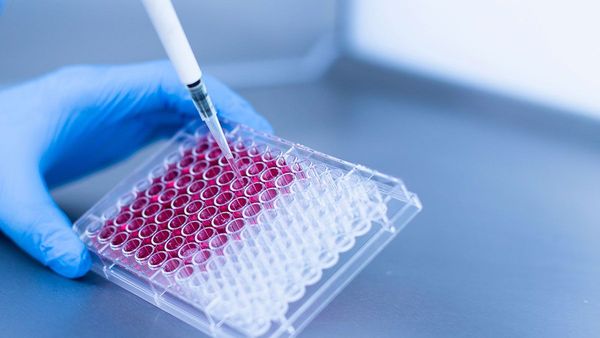
Effective analytics will eliminate failures, deviations, and non-conformances.

A radiotracer technique is a simple, fast, and sensitive technique for analyzing the integrity of clinical supply packages to water.
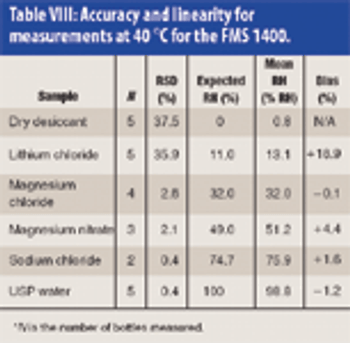
Frequency modulation spectroscopy is a nondestructive technology for determining the water activity of pharmaceutical samples. This article discusses the various pharmaceutical applications of frequency modulation spectroscopy, offers comparisons with various traditional water activity measurement techniques, and presents an assessment of various instrument performance elements.
Two scenarios demonstrate the need to use the percent of parent drug loss rather than the percent of degradation products formed when reconciling mass balance calculations.

Pharmaceutical Technology Europe
Chemical purity is the most important quality characteristic of a pharmaceutical substance. This article describes the latest scientific and technological advances to meet recent pharmacopoeial and regulatory requirements regarding the control of organic impurities in synthetically produced active substances. Future developments and suggestions for those working in quality control and raw material selection are discussed.

Pharmaceutical Technology Europe
Dust extraction and centralized vacuum cleaning systems vary in their design, performance and costs. Different companies have different approaches to their design, however, there are some basic rules that must be followed if these systems are going to be immediately effective and avoid future problems.

The global pharmaceutical industry is currently in a state of flux according to Frost & Sullivan.
Participants in a 2003 PhRMA workshop present the industry’s current thinking on developing analytical method equivalency, including the importance of sample selection, acceptance criteria, data evaluation, and documentation.

Pharmaceutical Technology Europe
IAdvances in pressurized metered-dose inhalers (pMDIs) in terms of formulation capability and the performance of the container closure system enable products to be developed faster and with less technical risk. Despite new delivery devices for new molecules breaking into the pMDI market, pMDIs have the ability to gain regulatory approval significantly faster than a novel device, which could save a company many hundreds of millions of pounds.

Pharmaceutical Technology Europe
Planning manufacturing capacity in the pharmaceutical industry is not for the faint-hearted. How can process designers help their clients to overcome some of the problems they face when planning to introduce new capacity? This article sets out to explain some of the techniques that are being employed in the early stages of project development.

Pharmaceutical Technology Europe
Contract manufacturers serving the biopharmaceutical market add capacity in a bet on renewed growth for biomanufacturing.
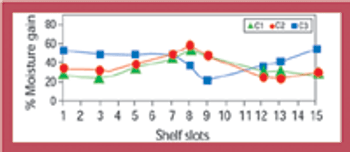
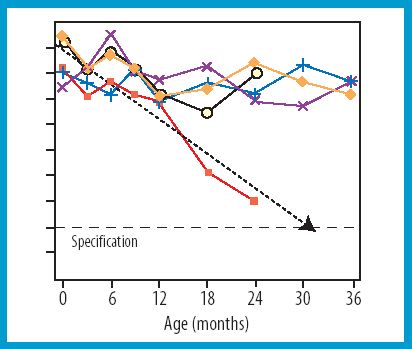
Stability data that do not follow the expected trend in comparison with other stability batches or previous results collected during a stability study are considered out-of-trend (OOT) results. OOT stability results recently have gained the attention of regulatory agencies and as a result, the approach for identifying and investigating OOT results has become a topic of increased discussion. One example is a 2003 article by the PhRMA Chemistry, Manufacturing, and Controls Statistics and Stability Expert Teams, which was intended to initiate dialogue on how to address OOT results (1).

Pharmaceutical Technology Europe
The first part of this article introduced the basic features of Raman spectroscopy and presented some examples of its application in the pharmaceutical industry. This second part focusses on the technique's application as a PAT tool within the pharmaceutical manufacturing environment. FDA's PAT initiative has provided motivation to explore the application of 'new' analytical technologies to the pharmaceutical manufacturing process and Raman spectroscopy shows great promise. The strengths and weaknesses of the technique as a potential PAT tool are discussed together with some examples of how this works in practice in a pharmaceutical manufacturing environment.

In his Feb. 2005 viewpoint article, "In Defense of Singlet Testing," Torbeck (1) draws an important philosophical distinction between "standards" and "specifications." He argues that specifications are criteria selected by manufacturers for statistical control of their products, whereas compendial standards are absolute requirements. This distinction is entirely compatible with modern concepts of statistical process control.

Pharmaceutical Technology Europe
Detection and identification of different polymorphic forms is, therefore, important throughout the drug development and manufacturing process.
Pharmaceutical Technology Europe
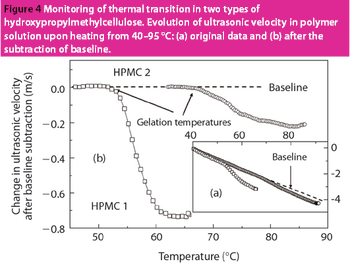
HR-US is a nondestructive technique with enormous potential for the analysis of materials and formulations used in the pharmaceutical industry.
Pharmaceutical Technology Europe
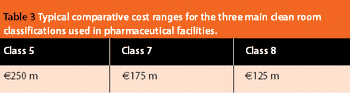
Possible cross-contamination issues should be eliminated at the early stage of the project. The project sponsor should ensure that all relevant personnel from the production, quality control, logistics, and maintenance departments, as well as engineering, are involved in the conceptual stages of a design.
Pharmaceutical Technology Europe
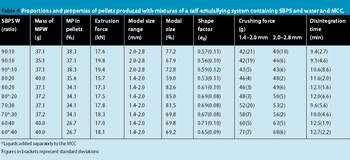
This high quality of pellet roundness is surprising in view of the high extrusion forces required to extrude the wet masses.
Glossary of computer and software terms.

The use of quality management software (QMS) to automate manufacturing quality processes quickly is becoming an industry-wide initiative. Companies are turning to commercial off-the-shelf systems (COTS) to simplify implementation and validation efforts. Regardless of the system selected, the automation of these critical quality processes is subject to electronic records and electronic signatures (ER/ES) requirements, as set forth in the 21 CFR Part 11 regulation (1). Therefore, companies must adopt a comprehensive but manageable approach to Part 11 compliance as they begin to automate the processes that support product quality and efficacy to ensure they meet the requirements of good manufacturing practices and all predicate rules.
New Chemical Reaction Method Accelerates Indole Production
A newly developed software program transforms written SOPs for all required analytical method validation experiments into transferable automated templates, integrating individual activities and technologies under one platform.
Pharmaceutical Technology Europe
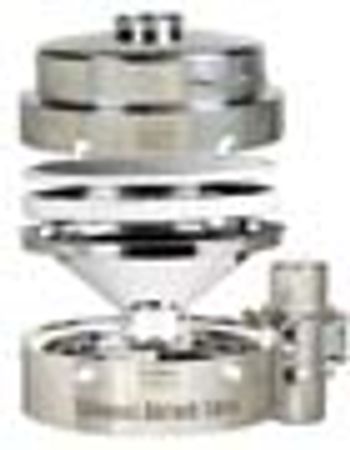
Asieve or screener is an essential part of every pharmaceutical production process, particularly as product quality and integrity are so important. The use of a sieve gets rid of oversized contamination to ensure that ingredients and finished products are quality assured during production and before use or despatch.
Pharmaceutical Technology Europe
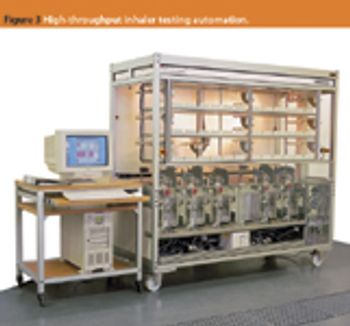
The FDA initiative —Process Analytical Technologies (PAT) — is slowly gaining momentum, creating a revolution in manufacturing and testing processes that aims to ensure product quality. Its growth will encourage faster testing techniques to bring analytical testing closer to on- and at-line testing during the product manufacturing process.
Pharmaceutical Technology Europe
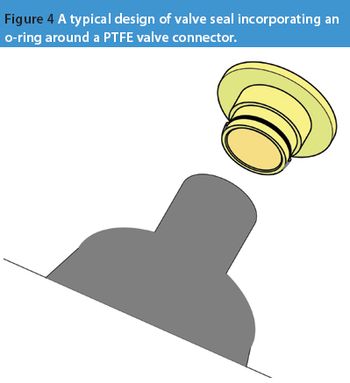
Active pharmaceutical ingredients (APIs) have become more potent, therefore the requirements of good manufacturing practice (GMP) are making ever more stringent demands on valve design and sealing. An absence of dead space, ease of cleaning and flushing is the norm for valves where cross contamination must be avoided at all costs. Sealing valves to glass reaction vessels has lagged behind valve sealing for steel vessels.