
The agency will review Mylan and Biocon’s biosimilar to pegfilgrastim.
The agency will review Mylan and Biocon’s biosimilar to pegfilgrastim.
PTSM: Pharmaceutical Technology Sourcing and Management
The agency recommends suspending drugs developed with bioequivalence studies performed at Semler Research Centre Private Ltd, Bangalore, India.
The agency has recommended granting marketing authorization in the EU for Truvada.
The company announced that its facilities and laboratories have completed FDA pre-qualification inspection.
The company manufactures biological drug products and intermediates for the allergy vaccine market.
The company voluntarily recalls all lots of lyophilized HCG and sermorelin.
PTSM: Pharmaceutical Technology Sourcing and Management
GenPak Solutions is cited by FDA for cGMP violations at its Hilliard, Ohio facility.
Generic versions of AstraZeneca’s blockbuster Crestor will hit the US market after a federal judge refused to issue a restraining order blocking the approval of rosuvastatin ANDAs.
The committee voted unanimously in favor of approving the drug, but the majority supported implementing additional risk management.
The company is voluntarily recalling a docusate sodium solution distributed by Rugby Laboratories due to risk of contamination.
FDA issued a warning letter to the Worthing, UK facility for cross contamination and microbial contamination cGMP violations.
The agency says the increasing requests for orphan drug designation has resulted in a change in FDA’s review goals.
The agency reviews hemophilia A, skin, and diabetes treatments, among others.
The agency completes its risk assessment of the blood cancer treatments.
The agency announced that it has completed the review of the GDUFA backlog one year ahead of schedule.
The agency says that the routine large-scale compounding of drugs that are exact copies of existing medications undermines the the drug approval process.
The draft guidance addresses control of elemental impurities in harmonization with implementation of ICH Q3D guideline.
FDA cited Guangzhou Haishi Biological Technology Co., Ltd. with CGMP violations.
Agency guidance and industry standards aim to reduce lapses and improve quality operations.
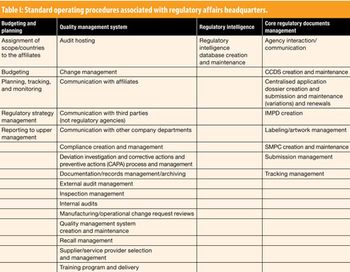
Siegfried Schmitt, Principal Consultant, PAREXEL International, discusses standard operating procedures for the regulatory affairs department.

Designing systems using the principles of good documentation practice, including validated audit trails, is a key piece of a manufacturing data integrity program.

Early planning for the integration of clean-in-place systems for equipment cleaning is key.
FDA approved the Raplixa, the first spray-dried fibrin sealant, in May 2015 to help control bleeding in adults during surgery.
China and India are also increasing inspections and becoming more exigent about data integrity and cGMPs.

Data integrity and cGMP issues demand closer scrutiny of suppliers. Bribery and corruption may become the next supply chain flashpoint.